The '78–'81 Story: How the Stones Met Mesa/Boogie
Historical Archive & Sound Notes · Main St Audio Labs
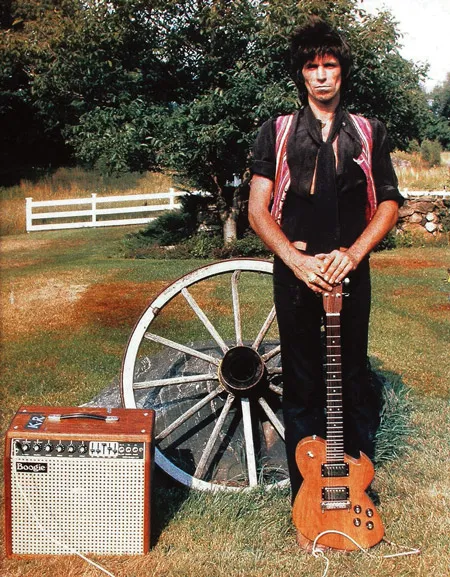
In the late 1970s, as the Rolling Stones were preparing for their Some Girls tour and a string of legendary studio sessions, a critical piece of their iconic guitar tone was forged—not in a massive London factory, but in a small "cottage industry" workshop in California. The story of how Keith Richards and the Stones acquired their legendary 100W Mesa/Boogie Mark I amplifiers is a fascinating chapter in rock history.
The Birth of the Boogie
The story begins with Randall (Randy) Smith, who started out modifying small Fender Princeton combos in the back of Prune Music, a store in Lagunitas / Mill Valley, California. Smith would take these modest practice amps and hot-rod them, stuffing them with massive Bassman transformers and high-gain circuits.
The legend goes that when Carlos Santana played one of these early modified prototypes, he famously exclaimed, "Man, that little thing really boogies!"—and thus, the Mesa/Boogie name was born.
These early Mark I amplifiers were revolutionary: they packed a staggering 100 watts of RMS power into a compact 1x12" format. To handle this immense power without blowing up, Smith loaded them with heavy-duty speakers, most notably the Electro-Voice EVM-12L or Altec 417, housed in beautifully crafted hardwood cabinets. The Mark I wasn't a channel-switcher in the modern sense; instead, it featured two inputs. Input 1 offered four stages of 12AX7-driven gain for searing lead tones, while Input 2 bypassed one stage for a cleaner, "hot-rodded Fender" rhythm tone.
The Call from Ian Stewart
By early 1977, the Rolling Stones were preparing for their first club dates in 14 years—the famous El Mocambo shows in Toronto, Canada, which would eventually make up side three of the Love You Live album. Word of these incredibly loud, touch-sensitive California amplifiers had reached the Stones' camp.
According to Randy Smith, the connection started with a surprising phone call. As Smith recalled: "At that point, building amps was a cottage industry and I did everything. So, I picked it up and it was [Stones pianist] Ian Stewart. He said, 'We're interested in trying a Boogie.' They'd heard a lot about them and asked if I would send some. I said, 'I really can't do that. I'm a one-person shop; I don't give away amps.' And he said, 'We're the Rolling Stones, we don't pay for amps.'"
During this brief stalemate, Smith could hear Keith Richards in the background, feeding lines to Stewart. Smith asked to speak to Richards directly.
"Keith gets on the line and he's just the best—super-friendly guy," Smith noted. "He says, 'Hey man. How you doing? Yeah, I'd love to get my hands on one of your amplifiers.' We went through the same thing and he said, 'Well, it just doesn't seem right. We haven't paid for gear in forever. We just don't.' I said, 'Well, I just don't give gear away because I'm basically just a starving cat here...'"
Smith, taking a massive gamble with one of the biggest rock bands on the planet, made a bold proposition: The Stones should buy the amp. If they didn't like it, they could send it back for a full refund. Or better yet, because there was such a massive waitlist for Boogies, they could simply sell it for a profit if it wasn't for them.
After a long, pregnant pause, Richards replied: "Well, yeah, mate. That would be a really good idea, except I already know I want the amp. There's no doubt about that. I played Santana's when he sat in with us. And I don't want just one, I want six of 'em."
The Mark I Hits the Stage and Studio
Those first six Mesa/Boogie Mark I amplifiers—featuring the 5-band graphic EQ and high-headroom speakers—became the cornerstone of the Stones' guitar sound for the next half-decade.
Photographs from the March 1977 El Mocambo shows clearly show Richards (and Ronnie Wood) playing their new hardwood Boogies. Richards' amp famously acquired a cigarette burn right above the Treble knob during these very gigs.
These amplifiers were subsequently packed up and shipped to Pathé Marconi Studios in Paris for the legendary Some Girls sessions later that year. The sheer headroom and articulate attack of the 100W 6L6 power section, combined with the precision of the graphic EQ, allowed Richards and Wood to craft tones that were punchy and clean, yet retained a gritty, muscular edge—perfectly cutting through the mix on tracks like "Beast of Burden" and "Shattered".
The Boogies remained the band's primary backline through the recording of Emotional Rescue (1979-1980 at Compass Point and Pathé Marconi) and Tattoo You (1981). Over the years, the Rolling Stones would go on to purchase—and fully pay for—over 40 Mesa/Boogie amplifiers.
The End of an Era and the Return to the Roots
The Mesa/Boogie Mark I (and later Mark II and III models) remained the undisputed core of Richards' guitar rig for over a decade. They powered the massive Steel Wheels tour in 1989 and were still heavily featured during his solo X-Pensive Winos tours in 1992 and 1993. In fact, that original 1977 Mark I (Serial Number A804) was sent back to the Mesa factory in California for a tune-up right before the '92 Winos tour.
However, by the mid-1990s (Voodoo Lounge and Bridges to Babylon), Keith began transitioning back to his roots. He rediscovered his love for the loose, organic, uncompressed crunch of 1950s Fender Tweed amplifiers—specifically the High Power Tweed Twins and Tweed Deluxes—which have remained the staple of his live and studio sound ever since.
🎸 Looking for that raw 50s Tweed tone?
If you want to experience the raw, touch-sensitive breakup of the Tweed era that Keith eventually returned to, check out our Midnight Rambler plugin—a faithful neural emulation of a cranked 1950s Tweed Deluxe (5E3).
Today, that original 1977 Mark I with the cigarette burn still exists, a physical testament to a pivotal moment when a boutique California amp builder helped redefine the sound of the world's greatest rock and roll band.
Story adapted from Dave Hunter's article "Keith Richards’ 1977 Mesa/Boogie Mark I" via Vintage Guitar® magazine. Read the full original article here.
If you have archival info or stories regarding the Stones' late '70s and early '80s studio rigs, we'd love to hear from you: