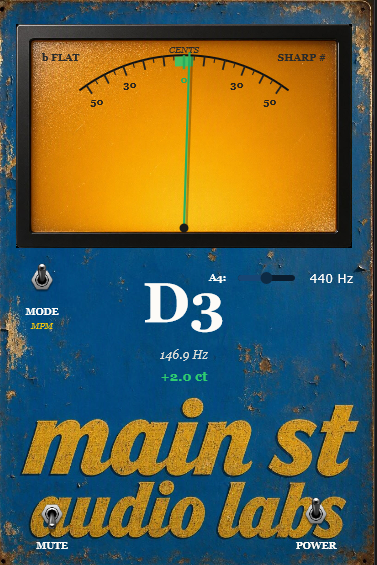
Vintage Tuner Stompbox
Analog Chromatic TunerVintage needle tuner powered by dual high-precision DSP engines (MPM & YIN). True 0.0% CPU when GUI is closed for inserting across all session tracks.
- Dual MPM + YIN engines
- 0.0% CPU with GUI closed
- Smooth analog-style needle
- Adjustable A4 calibration
- Works on every track
Developed by Main St Audio Labs · Open Source DSP Engine (MIT License)
What's new in 1.1.0
- Resizable window. At its old fixed size the pedal was a postage stamp on a 4K screen. Drag any corner, or right-click the background for preset sizes between 75% and 200%. The proportions stay locked — the chassis is a photograph, and stretching it ruins it — and your choice is saved with the project.
- The needle reacts in half the time. The analysis window was twice as long as it needed to be — it bought no extra precision, only latency.
- Much lower CPU while the window is open.
- More stable on low notes. Tested on a 5-string bass down to low B.
- Your A4 reference, algorithm and mute are now saved with the project. They used to reset to 440 Hz and MPM every time — annoying if you tune to 432, or a semitone down to play along with old records.
- On macOS, the first time: right-click the plugin and choose Open. It isn't signed with Apple — this is free software and signing carries an annual fee that we'd rather not pass on to anyone.
1. 🌟 Engineered for Stage and Studio
The Vintage Tuner Stompbox brings the visual warmth and ballistic precision of classic analog needle tuners straight to your DAW and live stage setup.
Built with a photorealistic retro chassis and cutting-edge DSP developed by Main St Audio Labs, it delivers rock-solid needle response tracking your tuning pegs smoothly without jitter, false octave jumps, or erratic screen flickering — performing effortlessly on acoustic guitars, electric guitars, drop tunings, and 5-string basses.
2. ⚡ Insert on Every Track: True 0.0% CPU Load
One of the greatest workflow advantages of Vintage Tuner Stompbox is its True Zero-CPU Passthrough architecture:
- 0.0% CPU When Window is Closed: When you close the plugin editor in your DAW or turn the
POWERswitch off, the mathematical analysis engine is immediately suspended and audio passes through cleanly without consuming a single CPU cycle. - Keep a Tuner on Every Track: You can leave the tuner instantiated across all guitar and bass tracks in your session ready for instant use without bogging down your CPU or session performance.
- Safety Auto-Unmute: Tuned your instrument on
MUTEand closed the window to start tracking or mixing? The plugin automatically unmutes output so your tracks never stay accidentally silenced.
3. 🎯 Dual Pitch DSP Engine for Guitar & Bass (Open Source)
The core pitch detection engine is powered by our in-house mathematical library, released as open-source under the MIT License on GitHub (pitch-detector-tuner):
🔀 Two Real-Time Selectable Modes:
- MPM Mode (McLeod Pitch Method): Tailored for electric and acoustic guitars. Instantly captures initial pick transients and responds with lightning speed to open chords and fast single-note runs.
- YIN Mode (De Cheveigné & Kawahara): Optimized for electric bass (4 and 5 strings), 7/8-string guitars, and dropped tunings (Drop D, Drop C, etc.). Tracks fundamental frequencies down to $B_0$ (Low B at 30.87 Hz / 25 Hz) with rock-solid stability.
🛡️ Smooth, Accurate, and Musical Ballistics:
- Anti-Jitter Exponential Smoothing: Direct first-order exponential smoothing with a calibrated center deadzone ($\pm 0.6\text{ cents}$) gives you clear, unambiguous tuning direction without distracting twitching.
- Decay Hold Window (~0.6 s): When a plucked string fades out, the needle holds its last measured pitch position and glides gently back to center instead of snapping to zero abruptly.
- Dynamic AGC (+41 dB Boost): Amplifies weak vintage single-coil pickups and decaying notes up to $+41\text{ dB}$ ($120\times$) without clipping.
- Intelligent Mono-to-Stereo Routing: Automatically mirrors single-channel audio interface inputs (Input 1) across both Left and Right headphone/monitor channels.
4. 🎛️ Quick Control Guide
+-------------------------------------------------------------+
|                      [ ANALOG VU METER ]                    |
|                 b FLAT     [-50 .. 0 .. +50]     SHARP #    |
|                                                             |
|   [ MODE ]               [ NOTE DISPLAY ]         [ A4 REF ]|
|   MPM / YIN                E2 · 82.4 Hz           440 Hz    |
|                            -0.5 cents                       |
|                                                             |
|   [ MUTE ]                                        [ POWER ] |
|   ON / OFF                                        ON / OFF  |
+-------------------------------------------------------------+- NEEDLE VU METER: Displays precise cents deviation (
-50to+50 cents). The center target band ($\pm 3\text{ cents}$) glows bright lime green when locked in tune. - MODE (MPM / YIN): Toggles between guitar-focused (MPM) and bass/low-register (YIN) algorithms.
- A4 REFERENCE (432 Hz - 448 Hz): Calibrates standard concert pitch. Double-click to reset instantly to 440.0 Hz.
- MUTE (Silent Tuning): Cuts audio passthrough to monitors/amps for silent stage and studio tuning.
- POWER: Master on/off switch. In OFF mode, the needle rests and audio passes in pure bypass (0% CPU).
- Custom Skins (Drag & Drop): Drag and drop any
.pngor.jpgimage directly onto the pedal to customize the enclosure or meter faceplate.
5. 💡 Best Practices: Signal Chain Placement & Pro Studio Tips
To get the most rock-solid tuning accuracy from Vintage Tuner Stompbox, keep these tracking and recording guidelines in mind:
🥇 Always Place in Slot #01 (First in Your FX Chain)
- Direct & Pure Signal (Clean DI): The tuner needs the unadulterated raw instrument signal directly from your interface or pickups before any other processor.
- Avoid Preceding Effects:
- Distortion, Overdrive, and Fuzz add harmonic saturation that masks the fundamental pitch.
- Chorus, Phasers, Flangers, and Vibrato modulate pitch over time, causing the needle to sway as it tracks the effect's modulation LFO.
- Delays and Reverbs superimpose echoes and acoustic decay of previous notes onto the note you are currently tuning.
- Clean Stage Mute: By placing the stompbox first, toggling
MUTEsilences the signal before high-gain amplifiers, providing true dead-quiet silence between songs without amplifier hum.
🎸 Playing Techniques for Surgical Pitch Tracking:
- Use the Neck Pickup: The neck pickup captures more fundamental energy and fewer harsh bridge harmonics. Rolling off the instrument's tone knob slightly creates a pure, sinusoidal wave that lets the algorithm lock in instantly.
- Gentle, Consistent Attack: Avoid striking the string violently with the pick, as intense transient string tension creates temporary pitch drift (sharp initial spike). Pluck gently near the 12th fret with your thumb or a smooth pick stroke.
- For 5-String Bass ($B_0$ @ 25 Hz): Ensure YIN mode is active for authoritative sub-bass fundamental tracking. You can also tune using the 12th-fret natural harmonic for instantaneous needle stabilization.
6. ⚙️ Recommended Buffer Settings
- Live Tracking & Stage:
- Set your interface buffer to 128 samples @ 48 kHz (~2.6 ms) using native ASIO (Windows) or CoreAudio (macOS) drivers for immediate, zero-latency monitoring.
- Mixing Sessions:
- Buffer sizes of 256 to 512 samples provide silky playback in heavy plugin chains without sacrificing tracking accuracy.
7. 🔬 Under the Hood: DSP Engineering & Real-Time Safety
For audio engineers and DSP developers, the plugin was developed in Modern C++ / JUCE following Main St Audio Labs Golden Standards:
- Asynchronous Audio Architecture: The real-time audio thread executes in
<0.5 microseconds, pushing samples into a lock-free circular ring buffer (16,384 samples). The mathematical autocorrelation analysis runs asynchronously in a dedicated worker thread every 10 ms (~100 FPS), ensuring zero audio dropouts or clicks. - Zero Dynamic Heap Allocations: All DSP memory and analysis buffers are strictly pre-allocated in
prepareToPlay(). - Denormal Number Protection (
ScopedNoDenormals): Eliminates CPU spikes during acoustic silence. - 100% Autonomous Portability with
BinaryData: All high-definition textures and assets are compiled directly into the plugin binary. - Open Source Repository: The underlying mathematical pitch detection algorithms are hosted on GitHub under the MIT License:
👉 https://github.com/mainstaudiolabs/pitch-detector-tuner
8. 💻 Compatibility & Downloads
| Operating System | Formats | Requirements |
|---|---|---|
| Windows | VST3 (64-bit), Standalone (.exe) | Windows 10 / 11 (64-bit) |
| macOS | VST3, AU (.component), Standalone (.app) | macOS 10.13+ (Universal: Apple Silicon M1/M2/M3 & Intel) |
| Linux | VST3 (64-bit), Standalone binary | Ubuntu 22.04+ or compatible 64-bit distribution |
- Installation: Extract the downloaded archive and place the
.vst3bundle into your default plugin folder (e.g.C:\Program Files\Common Files\VST3\on Windows).
9. 📄 License & Terms
- Vintage Tuner Stompbox is distributed as Freeware under the Main St Audio Labs EULA for personal and commercial musical productions.
- The DSP core is Open Source (MIT License) available at pitch-detector-tuner.
We want to hear your feedback!
Send us your thoughts, questions, or ideas at:
Other plugins
Main St 5E3
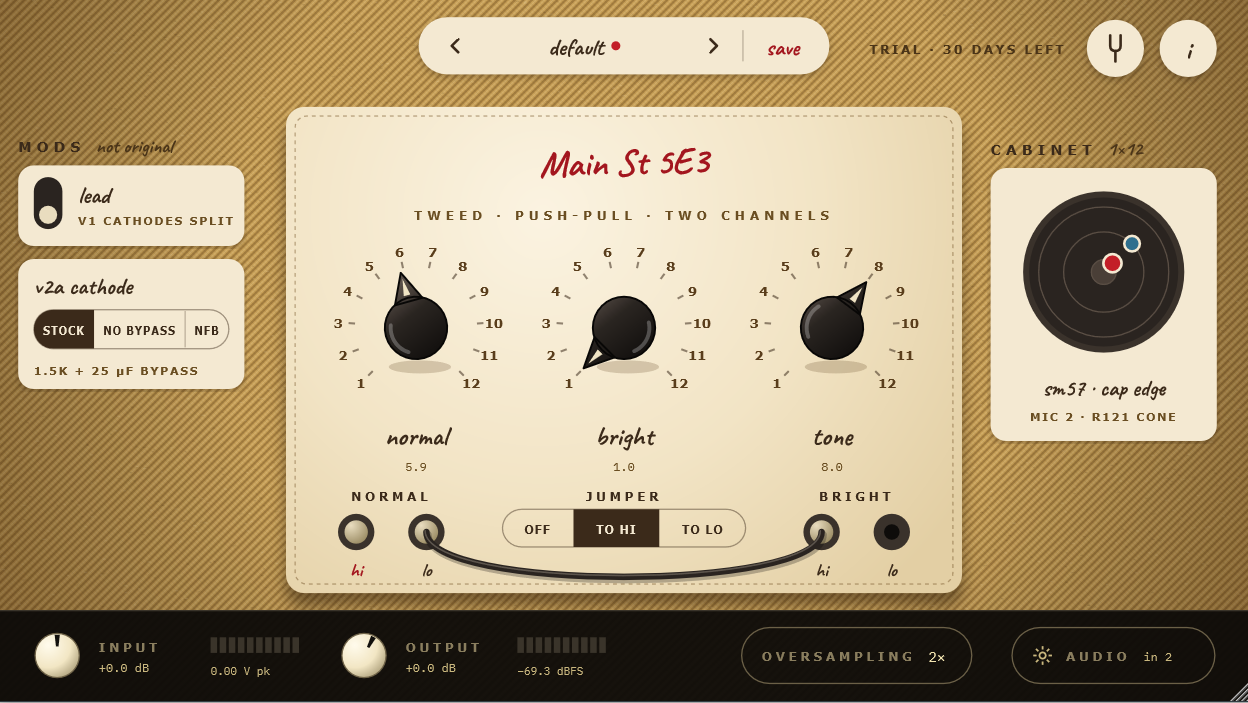
The original 5E3 tweed circuit, rebuilt tube by tube: two 12AY7 channels, a 12AX7, a pair of 6V6 power tubes and a 5Y3 rectifier, all working together as in the real amp. That's why it cleans up when you roll back your guitar's volume, sags and compresses when you dig in, and breaks into the famous tweed roar when you crank it.
Main St '63 Spring
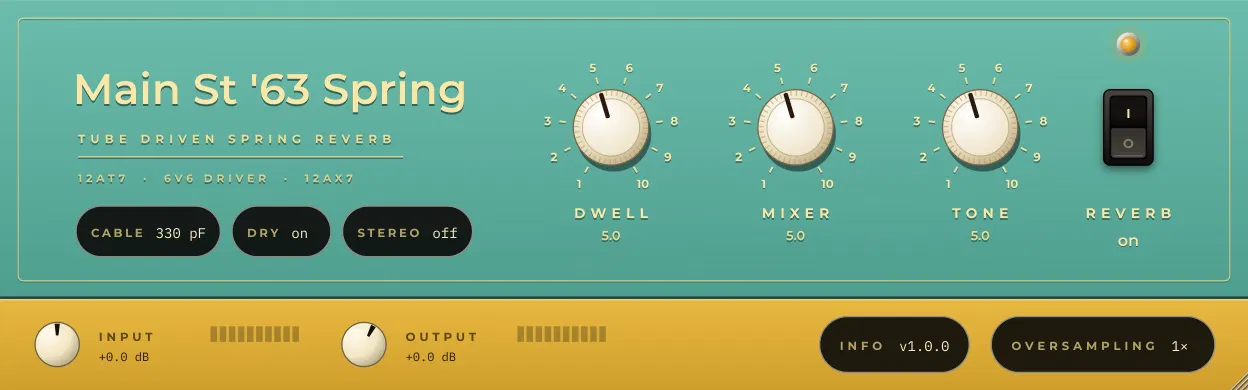
The original 1963 outboard spring reverb, rebuilt part by part: the tubes that drive the tank, the two springs and the recovery stage. That's where the drip and splash of surf and vintage records come from, and why it gets wetter and wilder as you turn up the Dwell and hit it harder. Use it before your amp like the original, or on a bus with the springs in stereo.
Main St 5F1
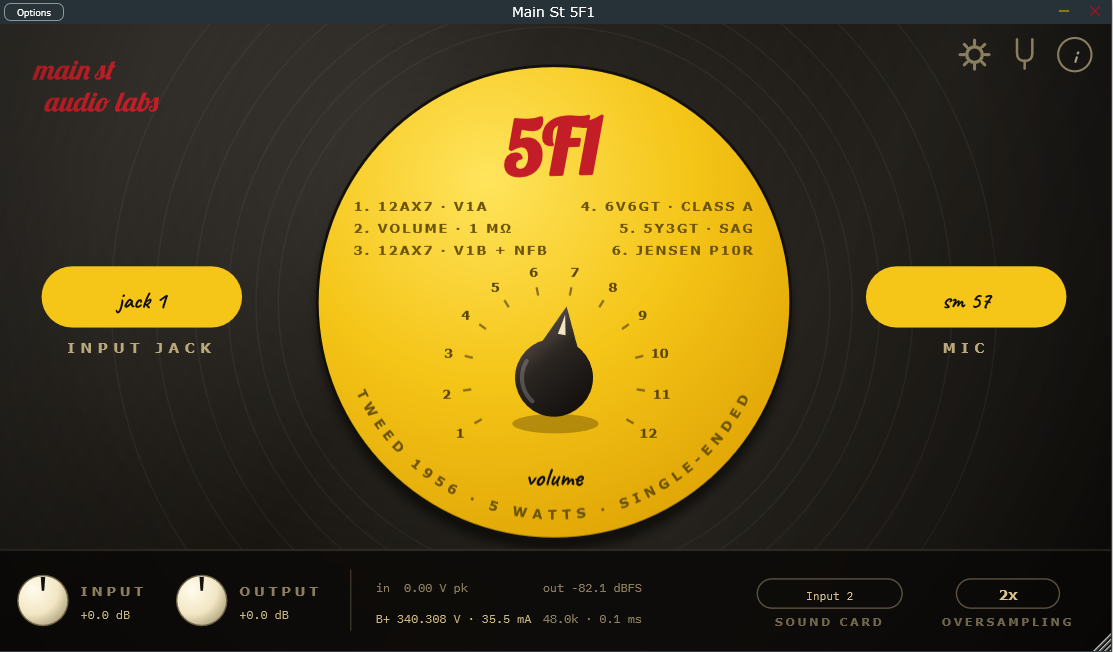
The original 1956 tweed Champ circuit, rebuilt tube by tube: a 12AX7, a single 6V6 and a 5Y3 rectifier, working together as in the real amp. That's why one knob covers it all (sweet cleans down low, warm crunch in the middle, singing overdrive at the top) and why it answers your picking like the real thing.
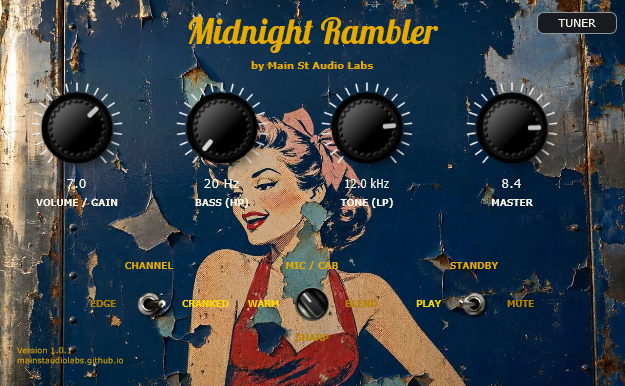
Midnight Rambler
The raw, dynamic bite of the Fender Tweed 5E3 behind rock's landmark albums. Organic touch sensitivity, 3 phase-aligned studio mics, and retro tuner.