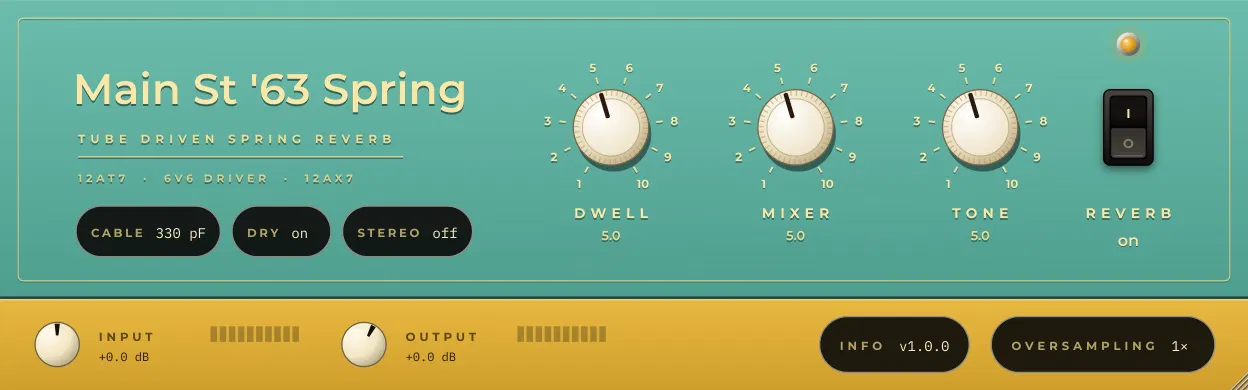
Main St '63 Spring
1963 Spring Reverb Unit · Tube DrivenThe original 1963 outboard spring reverb, rebuilt part by part: the tubes that drive the tank, the two springs and the recovery stage. That's where the drip and splash of surf and vintage records come from, and why it gets wetter and wilder as you turn up the Dwell and hit it harder. Use it before your amp like the original, or on a bus with the springs in stereo.
- 12AT7 input and 6V6 driver: more Dwell, a wetter and more aggressive splash
- Two dispersive springs, with the classic drip
- Dwell, Mixer, Tone and the reverb switch, like the unit
- DRY off and STEREO springs for buses
- Cable-length setting: darker as the cable gets longer
- Light on CPU
This manual describes the use, the design and the technical specifications of the Main St '63 Spring reverb.
Welcome
Main St '63 Spring simulates the whole 1963 Fender outboard spring reverb unit (the 6G15) — the box with its own tubes and tank that players put between the guitar and the amp. It is not an impulse response and not a generic spring algorithm: the circuit is solved sample by sample.
- Input stage: a 12AT7 (V1A and V1B) with the Dwell control, which sets how hard the tank is driven.
- Driver: a 6V6 feeding the tank's input coil through its transformer, loaded by the coil itself. Push the Dwell and the driver and the transducer start to compress, just like the real unit.
- Tank: two dispersive springs (a short one and a long one), with the chirps, the "drip" and the decay of a real tank.
- Recovery and mix: the 12AX7 recovery stage, the Tone control, and the Mixer, which blends the reverb with the dry signal that runs through a cathode follower (V3B), as in the original.
Use it before your amp, like the original, or on a bus with the dry signal off and the two springs split in stereo.
Fully functional and completely free. All features are available without time limits or functional restrictions. An optional license key is available to support development and remove the brief welcome window.
System Requirements
| Windows | 10 or later, 64-bit. Nothing else to install. |
| macOS | 10.13 High Sierra or later. Universal binary: runs natively on both Intel and Apple Silicon Macs. |
| Linux | x86_64, with glibc 2.35 or later (Ubuntu 22.04 and equivalents onward). |
| Formats | VST3 on all three systems; Audio Unit (AU) on macOS for Logic Pro and GarageBand. It is an effect for your DAW: there is no standalone application. |
| CPU | Light: about 4–5% of one core at 48 kHz with oversampling at 1× (STEREO adds about 7%). |
Installation
Copy the files to the appropriate folder for your operating system:
| Operating System | VST3 Format | AU (Audio Unit) Format |
|---|---|---|
| Windows | C:\Program Files\Common Files\VST3\ | — |
| macOS | ~/Library/Audio/Plug-Ins/VST3/ | ~/Library/Audio/Plug-Ins/Components/ |
| Linux | ~/.vst3/ | — |
Note for macOS users:
Because this is an independent project distributed without an Apple commercial developer certificate, macOS Gatekeeper may say the plugin is damaged or from an unidentified developer. It is neither: you will find two simple Terminal commands in the includedINSTALL.txtfile to authorize it in seconds.
Once copied, run a plugin rescan in your DAW. You will find it listed as Main St '63 Spring by Main St Audio Labs.
Two Ways to Use It
1. Like the real unit: on the guitar track, before the amp
This is how the '63 was used: guitar → reverb unit → amplifier. Insert Main St '63 Spring on your guitar track before your amp simulator (or send its output to a real amp). Leave DRY on and STEREO off: the unit passes the dry signal through its own tubes and blends the reverb with the Mixer, exactly like the original. Then the amp colors both together — that is the surf and classic rock sound.
The output uses the same voltage scale as the input, so it chains directly into the Main St 5F1 without changing levels.
2. As a studio reverb: on a send / bus
Put it on an aux / bus track and send guitars, drums or anything else to it:
- Set DRY to off: the plugin then returns only the reverb, and the Mixer becomes the reverb level. The tank's return is quiet on the real unit, so with DRY off the plugin adds +12 dB of make-up: with Output at 0 and the Mixer at 10, the reverb comes back close to the level you send it. Fine-tune it with Output.
- Turn STEREO on for width: the tank's short spring goes to the left and the long spring to the right.
- Set Input to taste: line-level mixes are much hotter than a guitar, so the higher you go, the more the 12AT7 and the 6V6 compress — that is the tube grit. Lower it for a cleaner, more open reverb.
Why does the dry signal not disappear with the Mixer at 10?
Because on the real unit it doesn't either: the Mixer is a 250 k pot between the reverb and the dry signal, and at 10 the dry still leaks through (we measured it at only about 5 dB below its maximum). That is part of the sound when the unit sits before an amp — and exactly why the plugin adds the DRY switch for bus use.
Controls
- Dwell (1–10): How hard the input stage and the 6V6 drive the tank. Low settings give a light, clean wash; from about 8 up the driver and the transducer compress and the reverb gets thicker and more aggressive.
- Mixer (1–10): The blend between dry and reverb (with DRY off, the reverb level).
- Tone (1–10): The treble of the reverb return, from dark to the bright, splashy surf tone.
- REVERB switch: Turns the reverb on and off, like the unit's footswitch. With DRY on, the dry signal keeps passing through the unit. The reverb fades in and out over a few milliseconds to avoid clicks. The amber pilot light shows the state (the original has none).
- CABLE (off, 330 pF, 680 pF, 2.2 nF): The capacitance of the cable from the unit to the amp, plus the amp input. Longer cables take some brightness off the output. 330 pF (about 3 m) is the default; 2.2 nF is a very long or heavy cable.
- DRY (on / off): On, like the unit. Off, reverb only (for sends and buses), with +12 dB of make-up on the return.
- STEREO (off / on): Off, mono like the unit (the same signal on both sides). On, the two springs are split: the short one on the left, the long one on the right. The input is always summed to mono, as in the unit, so the reverb does not follow panning. Each side is level-matched to the mono unit.
Double-click a knob to return it to 5. Hold Shift while dragging for fine adjustment. Changing CABLE or STEREO rebuilds the circuit, so the tail that was sounding is cut.
The Bottom Bar
- Input / Output: Digital trims in dB. Input sets how hot the signal enters the unit (see calibration below); Output is the final level.
- Meters and readings:
inshows the peak voltage entering the unit (V pk);outshows the output level in dBFS. - Oversampling (1×, 2×, 4×): Reduces aliasing in the input stage and the driver when they are driven hard. The tank always runs at its own internal rate. 1× is the default and what the model was validated at; 2× and 4× add 3 and 4 samples of latency, reported to your DAW.
- INFO: Version, how it's made, the website and your license key.
Input calibration
The reverb responds to the actual voltage at its input jack, just like the amps: a hot humbucker drives the 6V6 harder than a vintage single coil. 0 dBFS corresponds to 4.62 V peak at the jack (a Focusrite Scarlett 3rd gen at minimum gain, INST input). Strum hard and adjust Input so the in reading lands in the range of your pickups:
| Pickup Type | Suggested Peak on Hard Strum |
|---|---|
| Vintage Single-Coil | 0.4 – 1.0 V |
| Hot Single-Coil | 0.8 – 1.8 V |
| Vintage Humbucker | 1.0 – 1.8 V |
| Hot / High-Output Humbucker | 2.0 – 3.5 V |
| Active Pickups | 1.5 – 2.5 V |
Frequently Asked Questions
Why is the input mono?
The original unit is mono: one input, one tank. A stereo input is summed to mono. For width, use STEREO, which splits the tank's two springs.
Why is there no pre-delay?
The real unit has none: the first reflection arrives when the springs deliver it. If you want a gap before the reverb on a bus, a delay plugin before it on the bus does the job.
Why is the tail cut when I change CABLE, STEREO or OVERSAMPLING?
Those settings change the structure of the simulated circuit, so the plugin builds a new one and switches to it.
I entered my license key, but the welcome window still appears.
It appears at most once per session and only without a key. If it keeps appearing after you saved your key, write to us and we will help.
Credits & Trademarks
- Spring model after Välimäki, Parker and Abel (JAES 2010), Parker (EURASIP 2011) and Gamper, Parker and Välimäki (DAFx 2011).
- Tube mathematical models: Norman Koren (1996); grid current formulation: Dempwolf and Zölzer (DAFx 2011).
- Wave Digital Filters (WDF):
chowdsp_wdflibrary by Jatin Chowdhury (BSD-3 License). - Developed with the JUCE framework.
- Typefaces: Montserrat and IBM Plex Mono (SIL Open Font License 1.1).
All product names, trademarks, and registered trademarks mentioned (including Fender and Focusrite) are property of their respective owners and are referenced solely for historical context and descriptive identification of the modeled analog equipment. Main St Audio Labs is an independent developer and has no affiliation, endorsement, or commercial sponsorship from these companies.
If you record something with this reverb, we want to hear it. Copy our email to send us the link:
Other plugins
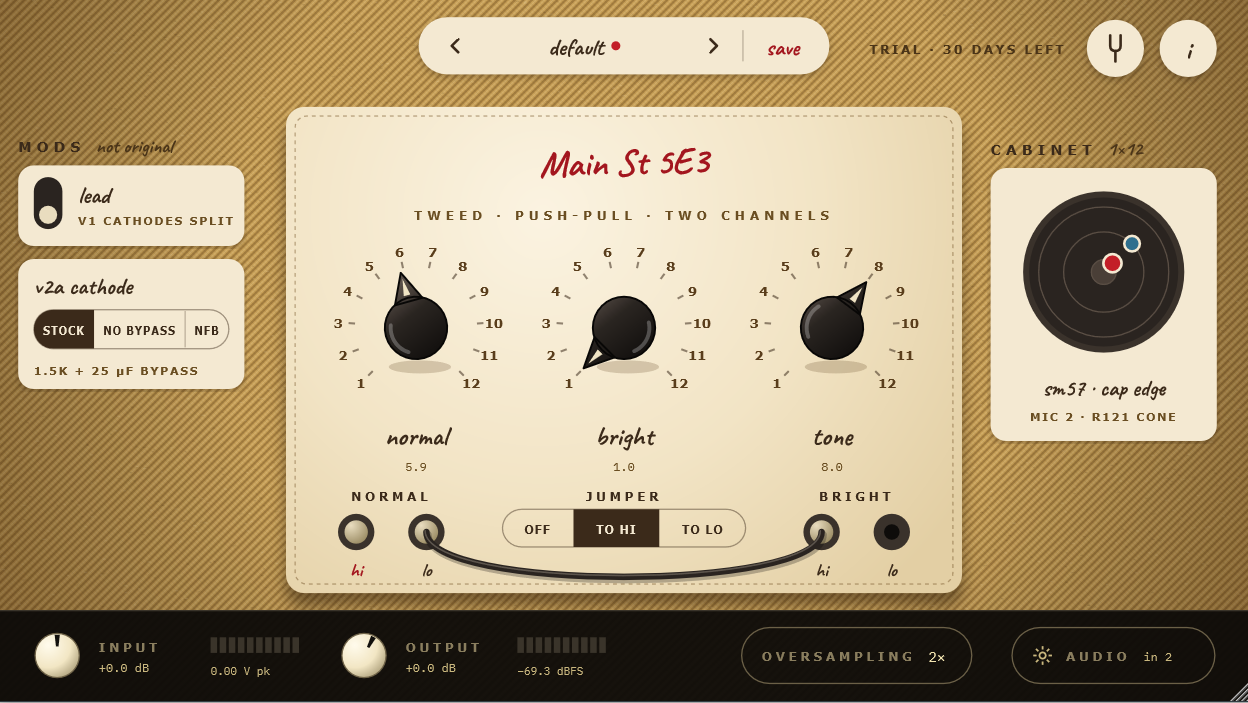
Main St 5E3
The original 5E3 tweed circuit, rebuilt tube by tube: two 12AY7 channels, a 12AX7, a pair of 6V6 power tubes and a 5Y3 rectifier, all working together as in the real amp. That's why it cleans up when you roll back your guitar's volume, sags and compresses when you dig in, and breaks into the famous tweed roar when you crank it.
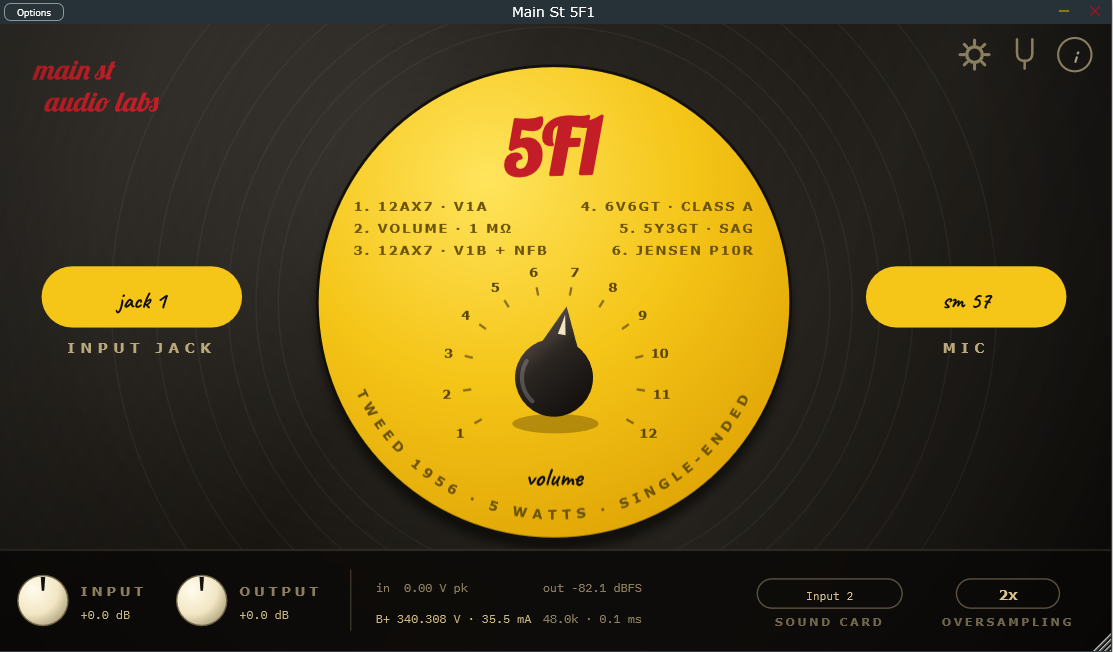
Main St 5F1
The original 1956 tweed Champ circuit, rebuilt tube by tube: a 12AX7, a single 6V6 and a 5Y3 rectifier, working together as in the real amp. That's why one knob covers it all (sweet cleans down low, warm crunch in the middle, singing overdrive at the top) and why it answers your picking like the real thing.
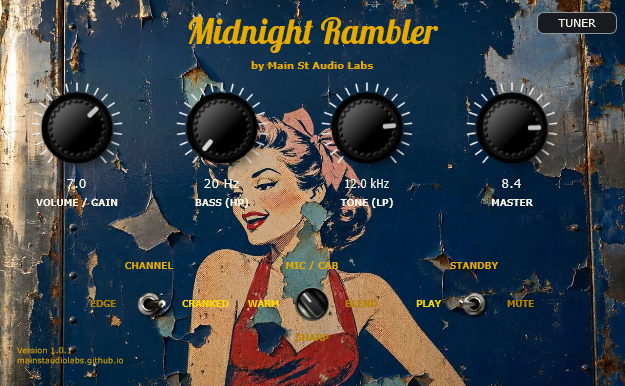
Midnight Rambler
The raw, dynamic bite of the Fender Tweed 5E3 behind rock's landmark albums. Organic touch sensitivity, 3 phase-aligned studio mics, and retro tuner.
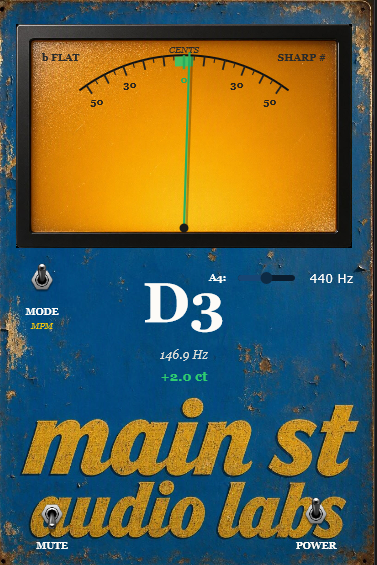
Vintage Tuner Stompbox
Vintage needle tuner powered by dual high-precision DSP engines (MPM & YIN). True 0.0% CPU when GUI is closed for inserting across all session tracks.