Appearance
← Back to Plugins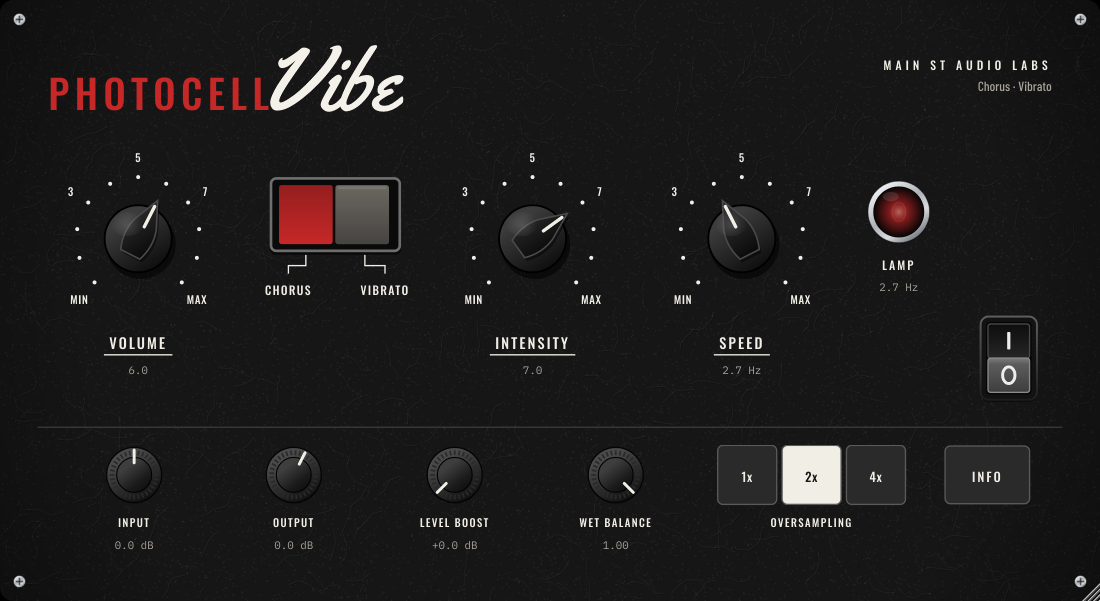
Photocell Vibe
Late-1960s Uni-Vibe (Shin-ei / Univox)
Lamp & Photocells · Chorus / Vibrato · Four Phase Stages🪟 Win🍎 Mac🐧 Linux
The late-1960s lamp-and-photocell vibe, rebuilt from its circuit: a real incandescent lamp, driven by the pedal's own oscillator, lights four photocells that move four transistor phase stages. The filament heats up fast and cools down slowly, so the sweep rises quickly and fades lazily: the lopsided, breathing throb no LFO can fake. CHORUS for the classic swirl, VIBRATO for pure pitch wobble.
Specifications
- The lamp and the four photocells modeled as physics, tuned against measurements of a real unit
- Four transistor phase stages matched to the original circuit, not textbook all-pass filters
- CHORUS (dry + wet) or VIBRATO (wet only), with the red and white key
- VOLUME, INTENSITY and SPEED (0.85 to 7.6 Hz), like the pedal
- A LAMP window that glows with the model's real bulb
- The preamp: clean with a normal guitar, a hard edge with a hot one
- Input calibrated to the voltage of a real guitar
- Very light on CPU
- Free and complete: no key, no time limit
This manual describes how to use Photocell Vibe and what each control does.
Welcome
Photocell Vibe is the late-1960s Uni-Vibe, the lamp-and-photocell "vibe" behind the swirl of countless records, rebuilt from its circuit. It is not a phaser with a vibe preset: what makes the original unique is modeled as physics, and the rest is matched to the real circuit.
- The lamp: a small incandescent bulb, driven by the pedal's own oscillator and lamp driver. Its filament heats up fast and cools down slowly, so the light rises quickly and fades lazily: the famous lopsided throb.
- The four photocells: each one sees the lamp a little differently and lags behind it in its own way. They move the four phase stages.
- The four phase stages: not textbook all-pass filters but the real transistor stages, matched to an analysis of the original circuit, each with its own capacitor, so the notches sweep unevenly across the spectrum.
- The preamp and the mixer: clean with a normal guitar, with a hard, asymmetric edge when you hit it with a hot signal; CHORUS blends the dry and the shifted signal, VIBRATO keeps only the shifted one.
The lamp and the cells were tuned against published measurements of a real unit, so the sweep, its speed and its shape follow the pedal rather than a math function.
Free, forever. No license key, no time limit and nothing locked. If Photocell Vibe earns a place on your board, the tip jar keeps the lights on.
System Requirements
| Windows | 10 or later, 64-bit. Nothing else to install. |
| macOS | 10.13 High Sierra or later. Universal binary: runs natively on both Intel and Apple Silicon Macs. |
| Linux | x86_64, with glibc 2.35 or later (Ubuntu 22.04 and equivalents onward). |
| Formats | VST3 on all three systems; Audio Unit (AU) on macOS for Logic Pro and GarageBand. It is an effect for your DAW: there is no standalone application. |
| CPU | Very light: on our test machine, about 0.5% of one core at 48 kHz at the default 2× oversampling (0.3% at 1×, 1.3% at 4×). |
Installation
Copy the files to the appropriate folder for your operating system:
| Operating System | VST3 Format | AU (Audio Unit) Format |
|---|---|---|
| Windows | C:\Program Files\Common Files\VST3\ | — |
| macOS | ~/Library/Audio/Plug-Ins/VST3/ | ~/Library/Audio/Plug-Ins/Components/ |
| Linux | ~/.vst3/ | — |
Note for macOS users:
Because this is an independent project distributed without an Apple commercial developer certificate, macOS Gatekeeper may say the plugin is damaged or from an unidentified developer. It is neither: you will find two simple Terminal commands in the includedINSTALL.txtfile to authorize it in seconds.
Once copied, run a plugin rescan in your DAW. You will find it listed as Photocell Vibe by Main St Audio Labs.
Where to Put It
1. In front of your amp (the default)
Put Photocell Vibe on the guitar track, before your amp simulator (or before the amp you re-amp through). The input is calibrated like our amps, to the voltage of a real guitar, so the preamp reacts to your picking like the pedal.
- The classic swirl: CHORUS, INTENSITY around 7, SPEED slow to medium.
- Pitch wobble: VIBRATO, INTENSITY up, SPEED to taste.
- Into a dirty amp: a vibe in front of a cranked amp is the classic pairing; VOLUME up pushes the amp a little harder.
2. After a drive
Like the pedal, it also sounds great after a fuzz or an overdrive. A hot signal from a fuzz drives the vibe's preamp into its own hard, asymmetric clipping, as on the real unit.
Controls
- VOLUME (0–10): The level of the effect, like the pedal's volume pot. At the default settings the effect sits close to the bypass level.
- CHORUS / VIBRATO: The red and white key. CHORUS mixes the dry and the phase-shifted signal: the notches sweep and you get the classic swirl. VIBRATO keeps only the shifted signal: a pure pitch wobble.
- INTENSITY (0–10): How deep the lamp sweeps. Low, a gentle shimmer; high, the lamp swings from dark to bright and the cells sweep wide.
- SPEED (0–10): From 0.85 to 7.6 Hz, shown under the knob. On the real unit it lives on a foot pedal: automate it in your DAW to play it the same way. As in the pedal, the oscillator gets stronger as it gets faster, so slow speeds sweep a little less.
- LAMP: A window onto the real lamp of the model: it glows and fades with the bulb, the quick rise and the slow fade included. It goes dark when the effect is off.
- I / O: Turns the effect on and off, with a short fade so it never clicks.
Double-click a knob to return it to its default.
The Bottom Panel
- INPUT (−24 to +24 dB): How hard the signal hits the pedal.
- OUTPUT (−36 to +24 dB): The final level.
- LEVEL BOOST (0 to +18 dB): Extra level for the effect only; the bypass is untouched. The original has no gain after its volume pot, so it starts at 0 dB.
- WET BALANCE (0.30–1.00): The chorus mix. 1.00 is the circuit as designed; lower values make the notches wider and shallower. It only acts in CHORUS.
- OVERSAMPLING (1×, 2×, 4×): 2× is the default and plenty at 48 kHz; 4× is there for very hot signals. 2× and 4× add 3 and 4 samples of latency, reported to your DAW. Switching it while playing may click.
- INFO: What the controls do, the version, the website and the tip jar.
You can resize the window from its corner; it keeps its size with your project.
Setting INPUT
The pedal responds to the actual voltage at its input jack, like our amps. 0 dBFS corresponds to 4.62 V peak at the jack (a Focusrite Scarlett 3rd gen at minimum gain, INST input). The vibe's preamp stays clean with a normal guitar and starts to clip at about 1.15 V peak at the jack: hot humbuckers, active pickups or a booster in front push it there, just like the real pedal.
| Pickup type | Normal playing | Hard strum |
|---|---|---|
| Vintage single coil (Strat, Tele) | 0.05 – 0.10 V | 0.3 – 0.5 V |
| Hot single coil, P-90 | 0.10 – 0.20 V | 0.5 – 0.8 V |
| Humbucker (PAF style) | 0.10 – 0.25 V | 0.6 – 1.0 V |
| Hot humbucker | 0.20 – 0.40 V | 1.0 – 1.5 V |
| Active pickups | 0.30 – 0.60 V | 1.5 – 2.5 V |
If your interface gives you a hotter or quieter signal, use INPUT to bring it into that range, and OUTPUT to set the final level.
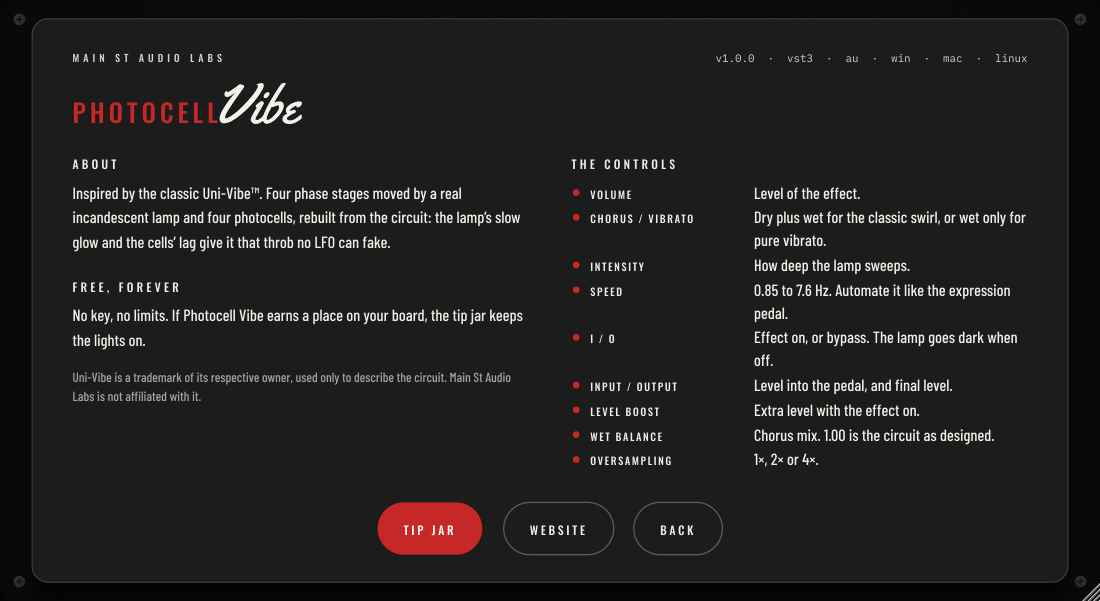
Info
Click INFO to open the info panel: what each control does, the version, the website and the tip jar. Click BACK, or anywhere outside the card, to close it.
Frequently Asked Questions
Is it a chorus or a vibrato?
Both, like the original. CHORUS mixes in the dry signal, so the sweeping notches give the swirl; VIBRATO is only the shifted signal, a pitch wobble. Neither is a modern chorus: there is no delay line, only four phase stages moved by light.
Why doesn't the sweep sound perfectly even?
Because the lamp heats up faster than it cools down, and each photocell lags behind it in its own way. That uneven, breathing sweep is the sound of the original.
Why is it mono?
Like the pedal, it is mono. A stereo input is summed to mono, and both outputs carry the same signal.
Is it really free?
Yes. No key, no time limit, nothing locked. The tip jar is there if you want to support the lab.
Credits & Trademarks
- An original model of the circuit by Main St Audio Labs, matched to a nodal analysis of the original phase stages and to published measurements of a real unit (Darabundit, Wedelich and Bischoff, DAFx-19).
- Typefaces: Oswald, Barlow Condensed and IBM Plex Mono (SIL Open Font License 1.1); Yellowtail (Apache License 2.0).
- Developed with the JUCE framework.
All product names, trademarks, and registered trademarks mentioned (including Uni-Vibe, Univox, Shin-ei and Focusrite) are property of their respective owners and are referenced solely for historical context and descriptive identification of the modeled analog equipment. Main St Audio Labs is an independent developer and has no affiliation, endorsement, or commercial sponsorship from these companies.
If you record something with Photocell Vibe, we want to hear it. Copy our email to send us the link:
mainstaudiolabs@gmail.com
Other plugins
New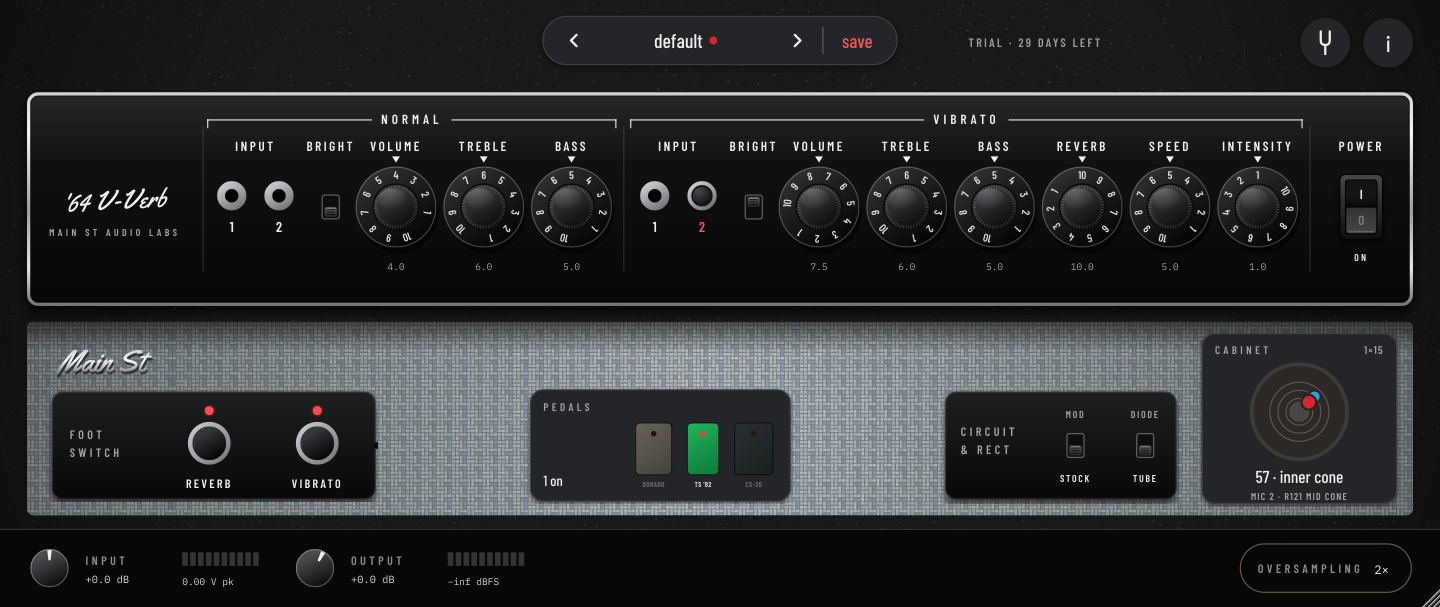
Main St '64 V-Verb
1964 Fender Vibroverb (blackface, 1x15)
The 1964 blackface Vibroverb, rebuilt tube by tube: two channels, a tube-driven spring reverb, the optical vibrato, a pair of 6L6GC, a GZ34 rectifier and a 15" speaker, all working together as in the real amp. Big, round cleans with a lot of headroom, deep reverb and a throbbing vibrato, and a thick, singing edge when you turn it up. With the '64 Custom switches and a pedalboard in front: a compressor and two overdrives.
$19 · trialView details
New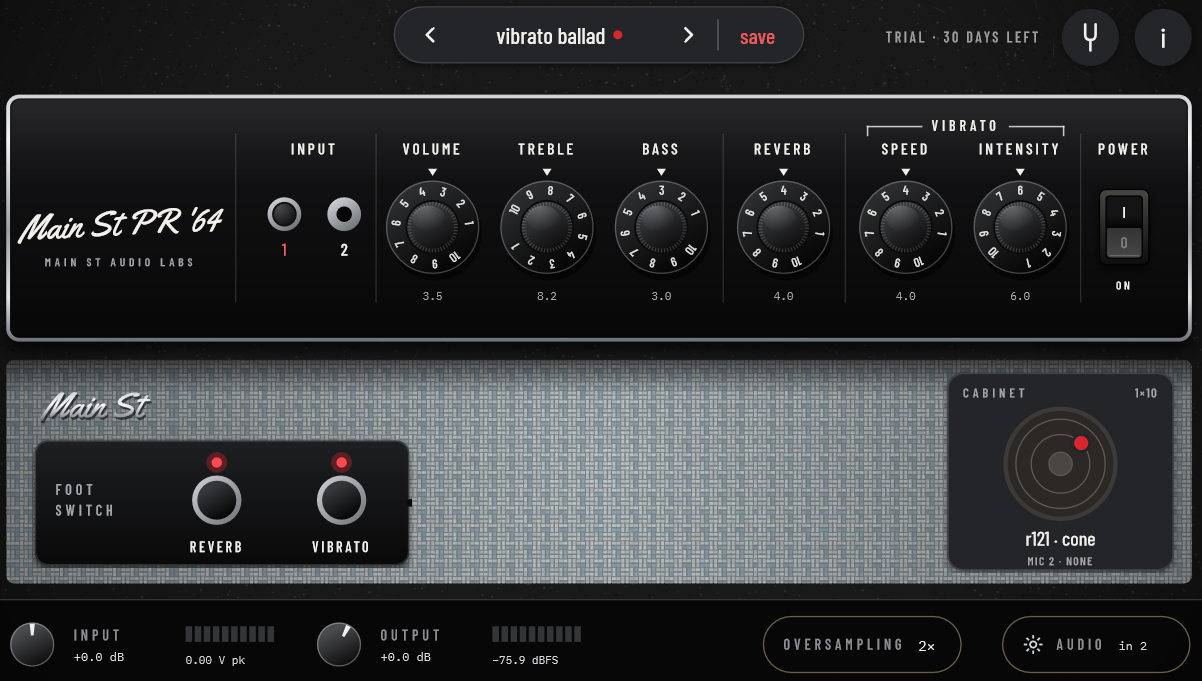
Main St PR '64
1964 Fender Princeton Reverb (blackface)
The 1964 blackface Princeton Reverb, rebuilt tube by tube: the preamp with Treble and Bass, a tube-driven spring reverb, the bias tremolo, a pair of 6V6 and a GZ34 rectifier, all working together as in the real amp. That's why the cleans sparkle and the reverb blooms off your picking, why it gets a warm, singing edge when you turn it up, and why the Vibrato pulses like the real one.
$14 · trialView details
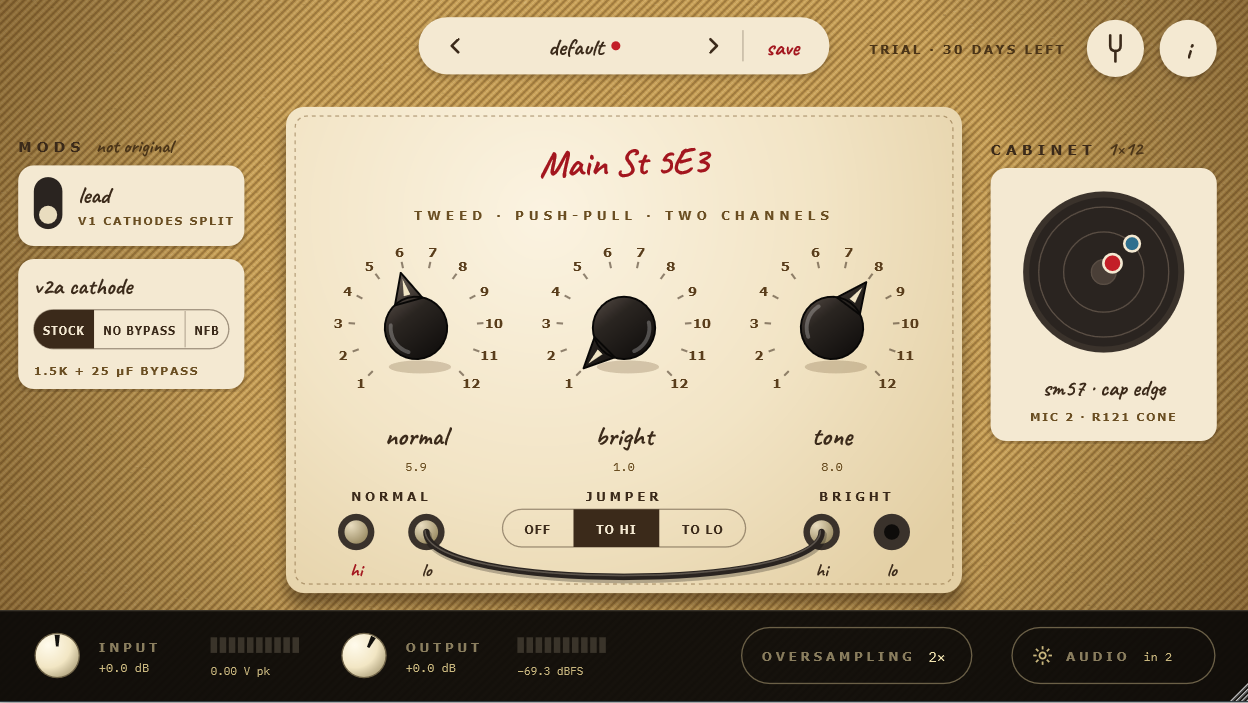
Main St 5E3
Fender Tweed Deluxe 5E3 (1955–60)
The original 5E3 tweed circuit, rebuilt tube by tube: two 12AY7 channels, a 12AX7, a pair of 6V6 power tubes and a 5Y3 rectifier, all working together as in the real amp. That's why it cleans up when you roll back your guitar's volume, sags and compresses when you dig in, and breaks into the famous tweed roar when you crank it.
$9 · trialView details
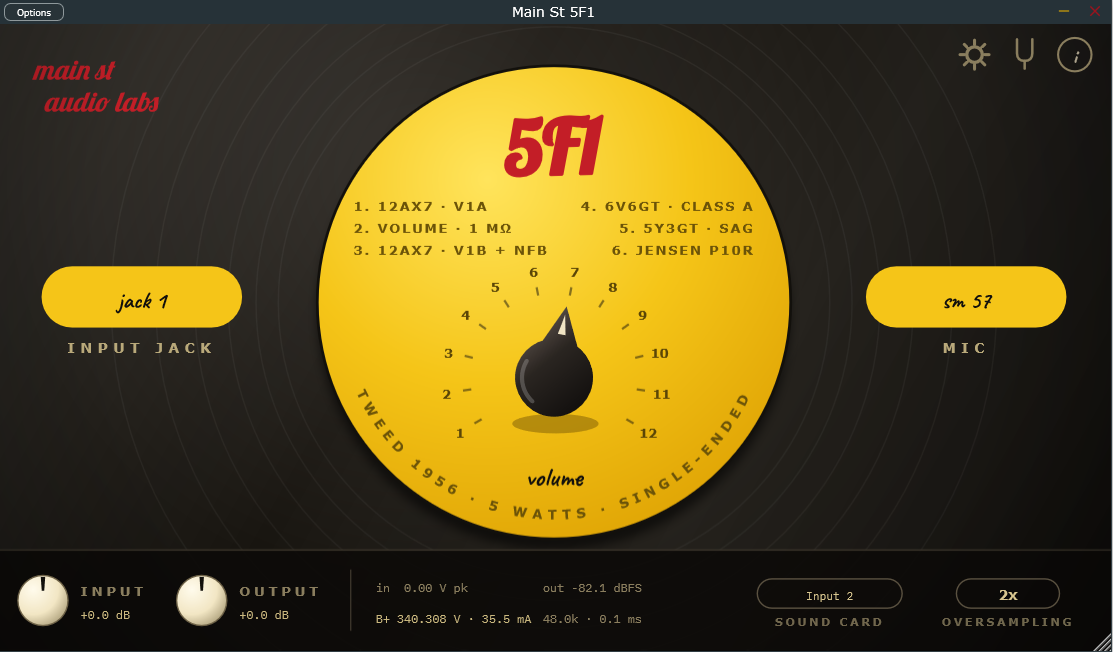
Main St 5F1
1956 Fender Tweed Champ 5F1
The original 1956 tweed Champ circuit, rebuilt tube by tube: a 12AX7, a single 6V6 and a 5Y3 rectifier, working together as in the real amp. That's why one knob covers it all (sweet cleans down low, warm crunch in the middle, singing overdrive at the top) and why it answers your picking like the real thing.
FreeView details
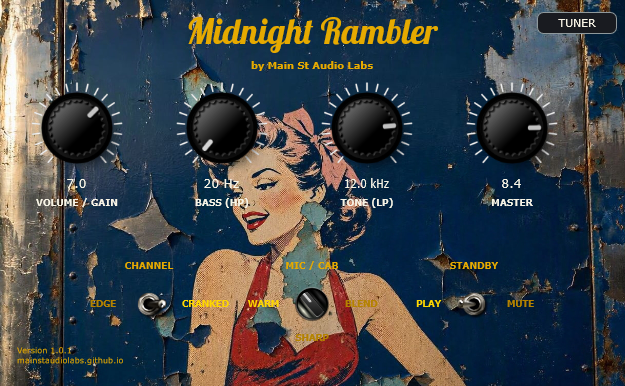
Midnight Rambler
Fender Tweed Deluxe 5E3 · lite
The raw, dynamic bite of the Fender Tweed 5E3 behind rock's landmark albums. Organic touch sensitivity, 3 phase-aligned studio mics, and retro tuner.
FreeView details
New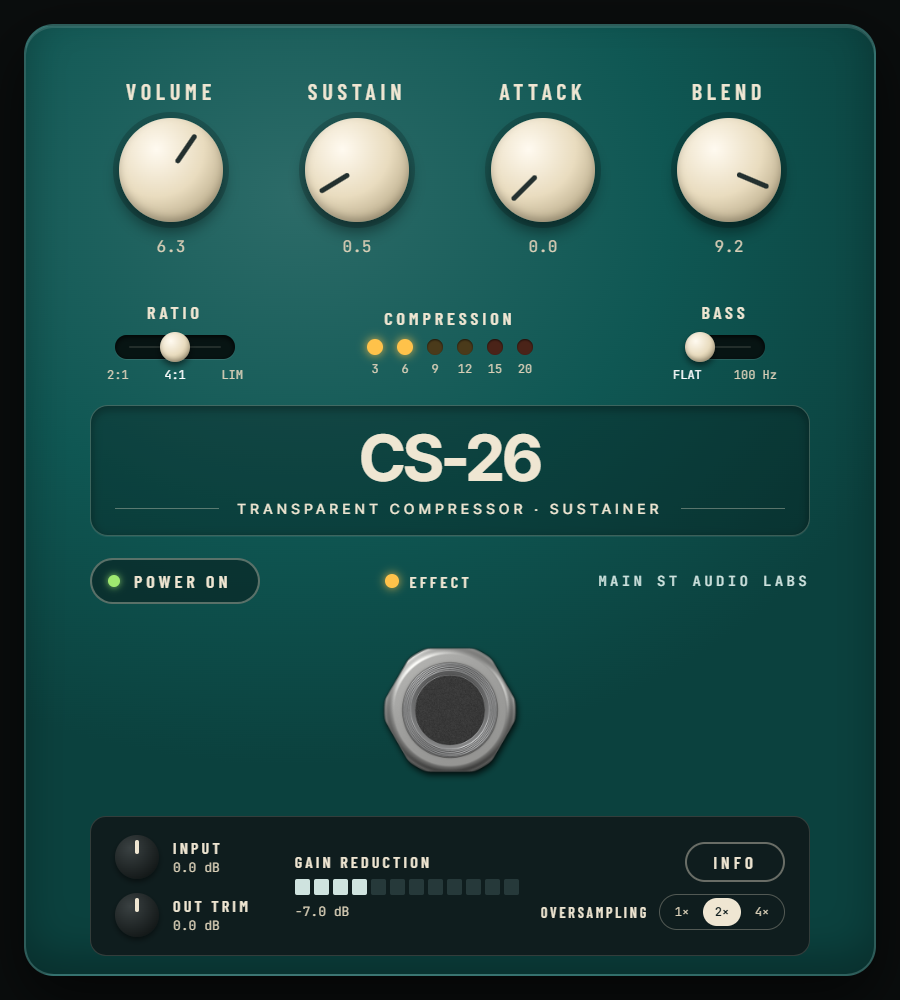
CS-26
Original Main St design
Our own compressor, designed from scratch for guitar: it evens out your playing and adds sustain without changing your tone. BLEND brings the clean signal back in so your pick attack stays alive, a 100 Hz switch keeps the low strings from pumping, and a row of LEDs shows how hard it's working. Free, with no key and no limits.
FreeView details
New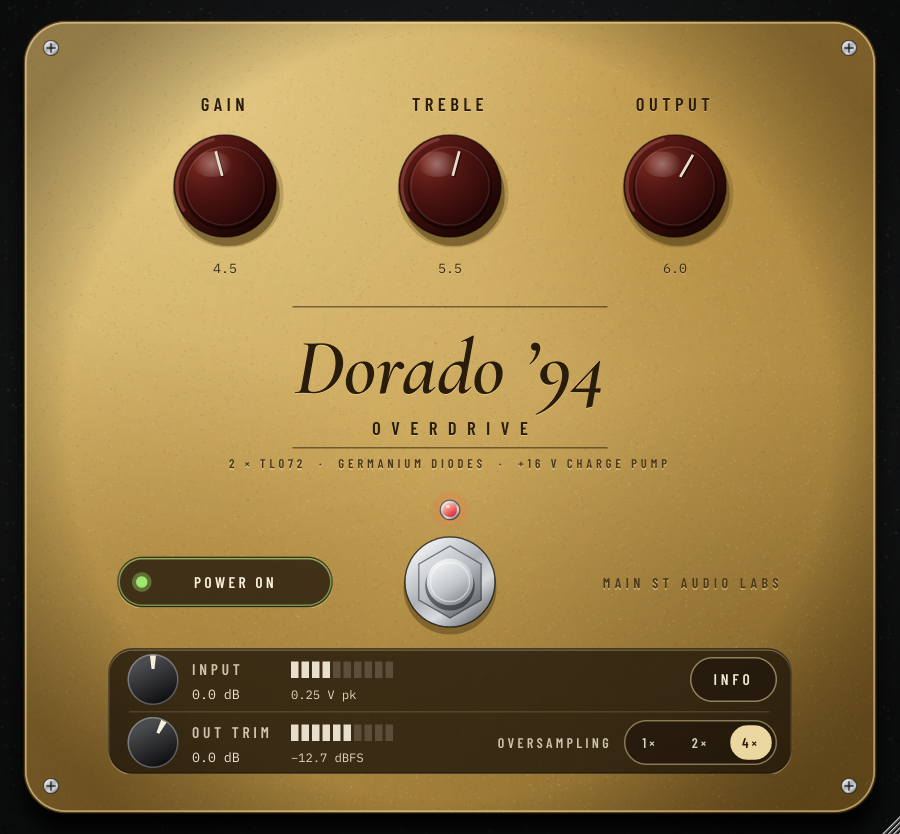
Dorado '94
1994 Klon Centaur overdrive
The famous 1994 transparent overdrive, rebuilt part by part: the buffer, the gain section with its germanium diodes and the clean signal running alongside, the treble control on its charge-pump rails and the original buffered bypass. That's why it thickens your tone instead of replacing it, works as a clean boost with GAIN low, and pushes an amp into singing overdrive when you turn it up.
FreeView details
New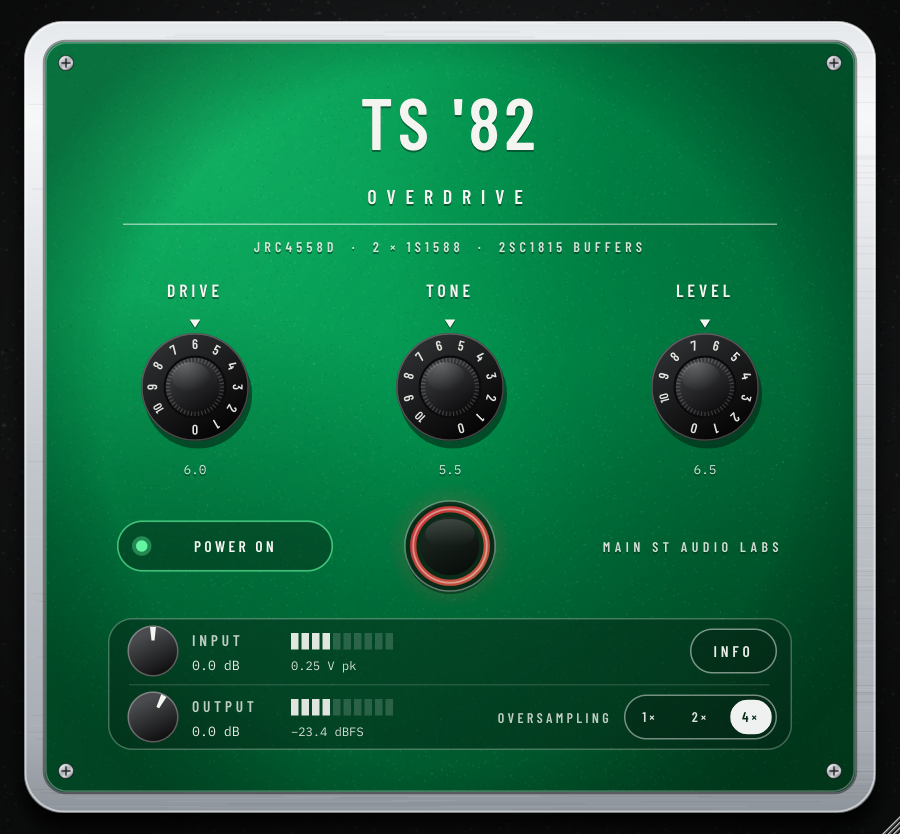
TS '82
1982 Ibanez TS9 Tube Screamer
The 1982 green overdrive, rebuilt part by part: the two transistor buffers, the JRC4558D clipping stage with its silicon diodes, the tone control and the original buffered bypass. That's where the famous mid hump comes from, the tight low end and the smooth clipping that tames your amp, whether you use it for overdrive or as a boost in front of a dirty amp.
FreeView details
New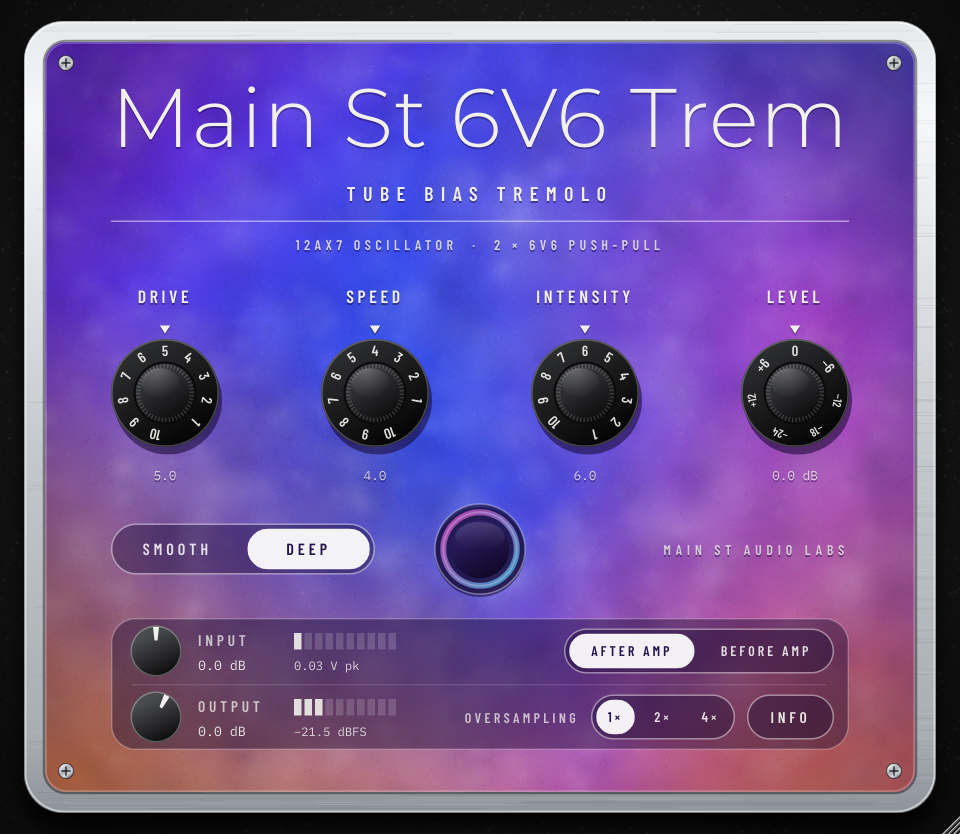
Main St 6V6 Trem
The bias tremolo of the 1964 Princeton Reverb
The bias tremolo of the 1964 blackface Princeton Reverb, taken out of the amp and built into a pedal, tube by tube: the oscillator tube, the bias supply and a push-pull pair of 6V6 with their output transformer. The power tubes make the tremolo, so the pulse is round and warm, it breathes with your playing and each valley gets a little dirty. SMOOTH is the original circuit; DEEP goes all the way down to silence.
FreeView details
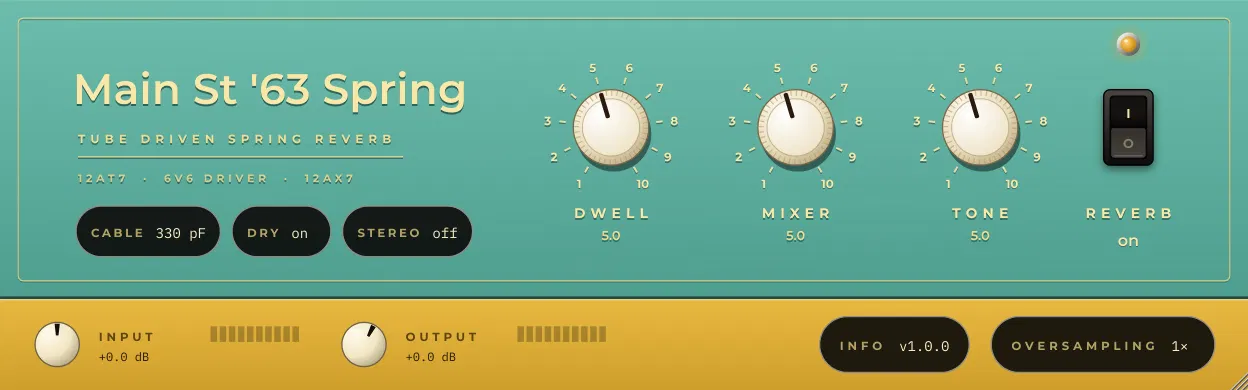
Main St '63 Spring
1963 Fender Reverb Unit (6G15)
The original 1963 outboard spring reverb, rebuilt part by part: the tubes that drive the tank, the two springs and the recovery stage. That's where the drip and splash of surf and vintage records come from, and why it gets wetter and wilder as you turn up the Dwell and hit it harder. Use it before your amp like the original, or on a bus with the springs in stereo.
FreeView details
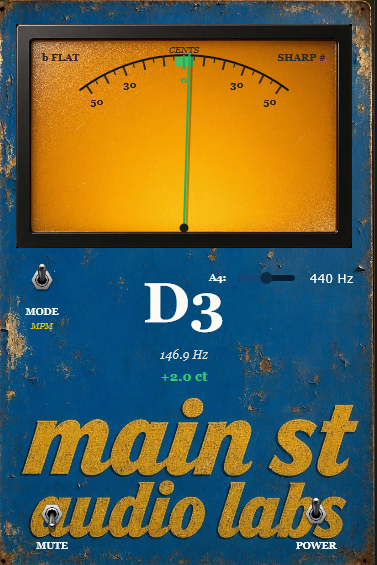
Vintage Tuner Stompbox
Chromatic needle tuner
Vintage needle tuner powered by dual high-precision DSP engines (MPM & YIN). True 0.0% CPU when GUI is closed for inserting across all session tracks.
FreeView details