Appearance
← Back to Plugins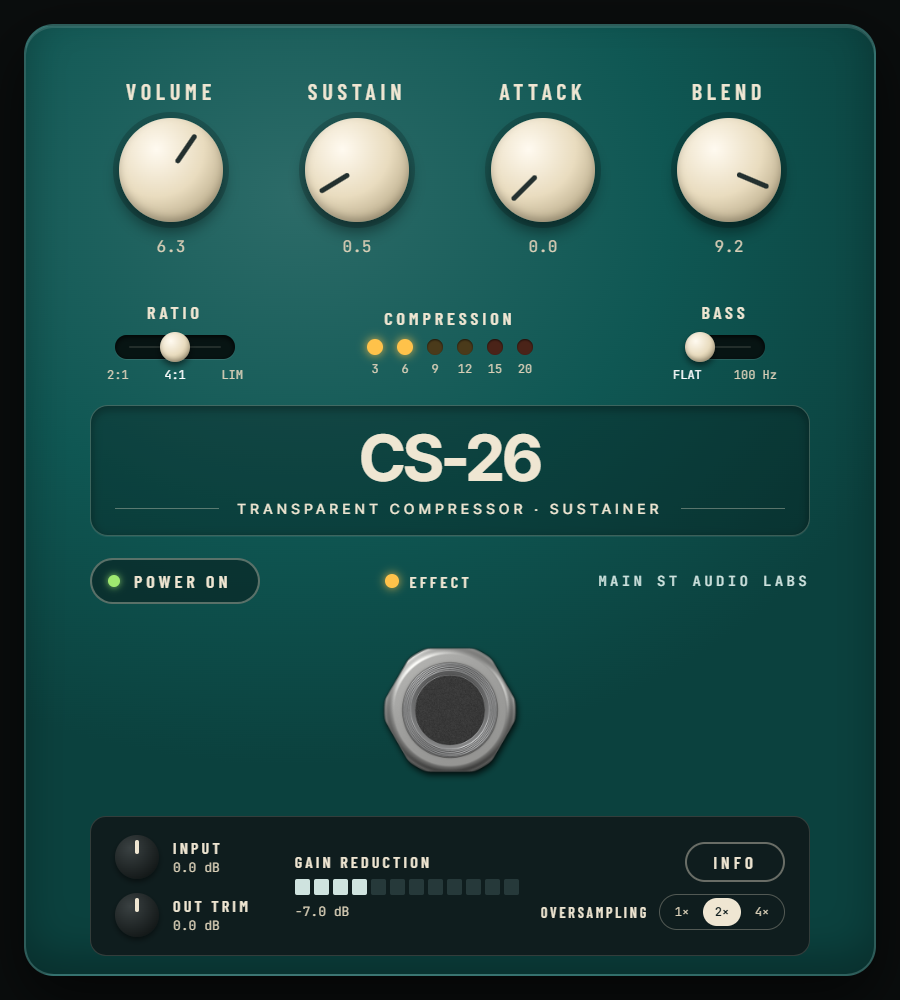
CS-26
Original Main St design
Transparent Compressor · Sustainer · Blend🪟 Win🍎 Mac🐧 Linux
Our own compressor, designed from scratch for guitar: it evens out your playing and adds sustain without changing your tone. BLEND brings the clean signal back in so your pick attack stays alive, a 100 Hz switch keeps the low strings from pumping, and a row of LEDs shows how hard it's working. Free, with no key and no limits.
Specifications
- An original circuit, designed from scratch and simulated part by part
- Transparent: your tone stays yours, only the dynamics change
- SUSTAIN, ATTACK, BLEND and VOLUME, like a pedal on your board
- RATIO: 2:1 gentle, 4:1 firm, LIM for limiting
- BASS 100 Hz: low notes stop pumping the compressor
- Six LEDs from 3 to 20 dB, plus a gain reduction meter
- VOLUME at 6.3 matches the bypass level
- Click-free footswitch and a POWER switch for 0% CPU
- Free and complete: no key, no time limit
This manual describes how to use the CS-26 compressor and what each control does.
Welcome
CS-26 is a compressor for guitar that adds sustain, and the first pedal in the line that is entirely our own design. We drew the circuit from scratch, built it on paper part by part and simulated it the same way we simulate the classic pedals and amps: every part of the circuit is solved in real time, not sampled.
It was designed to be transparent. Your guitar, your pickups and your amp still sound like themselves; what changes is the dynamics. Soft notes come up, hard picking gets tamed, and long notes ring longer.
- SUSTAIN sets how much it compresses.
- ATTACK decides how much of the pick attack gets through before the compressor grabs the note.
- BLEND mixes your clean signal back in, so the attack stays alive even with a lot of compression.
- RATIO goes from gentle to limiting, and BASS keeps low notes from pumping the compressor.
- A row of LEDs shows how hard it is working.
Free, forever. No license key, no time limit and nothing locked. If the CS-26 earns a place on your board, the tip jar keeps the lights on.
System Requirements
| Windows | 10 or later, 64-bit. Nothing else to install. |
| macOS | 10.13 High Sierra or later. Universal binary: runs natively on both Intel and Apple Silicon Macs. |
| Linux | x86_64, with glibc 2.35 or later (Ubuntu 22.04 and equivalents onward). |
| Formats | VST3 on all three systems; Audio Unit (AU) on macOS for Logic Pro and GarageBand. It is an effect for your DAW: there is no standalone application. |
| CPU | Light: on our test machine, about 4% of one core at 48 kHz at the default 2× oversampling (about 2% at 1×). When the track is silent or POWER is off, practically nothing. |
Installation
Copy the files to the appropriate folder for your operating system:
| Operating System | VST3 Format | AU (Audio Unit) Format |
|---|---|---|
| Windows | C:\Program Files\Common Files\VST3\ | — |
| macOS | ~/Library/Audio/Plug-Ins/VST3/ | ~/Library/Audio/Plug-Ins/Components/ |
| Linux | ~/.vst3/ | — |
Note for macOS users:
Because this is an independent project distributed without an Apple commercial developer certificate, macOS Gatekeeper may say the plugin is damaged or from an unidentified developer. It is neither: you will find two simple Terminal commands in the includedINSTALL.txtfile to authorize it in seconds.
Once copied, run a plugin rescan in your DAW. You will find it listed as CS-26 by Main St Audio Labs.
Where to Put It
1. First on the guitar track (the default)
A compressor usually goes first, right after the guitar: before your drive pedals and before your amp simulator. Insert CS-26 at the top of the guitar track. The input is calibrated like our amps, to the voltage of a real guitar, so SUSTAIN behaves like it would on a pedal at the front of your board.
2. After a drive pedal or the amp
After a drive it tames the level jumps and smooths the decay; after the amp it works more like a studio compressor on the track. Mix-level signals are much hotter than a guitar, so lower INPUT there, or the compressor will work harder than you want.
Controls
- SUSTAIN (0–10): How much it compresses. Low settings only catch the hardest notes; turn it up and even soft playing is lifted and held, and long notes ring longer. The factory setting (0.5) is a gentle touch that evens out your picking without being heard.
- ATTACK (0–10): How quickly it grabs each note. At 0 (the default) it catches the pick right away, for an even, smooth sound. Turn it up and more of the pick attack gets through before the compressor clamps down, so the playing sounds punchier.
- BLEND (0–10): The mix between your clean signal (0) and the compressed one (10). In between, the clean signal brings back the attack and the natural dynamics while the compressed one adds the sustain underneath. The default is 9.2.
- VOLUME (0–10): The output level. At 6.3 the pedal is at the same level as bypass, with any SUSTAIN setting; from there up to +12 dB of boost. The compressor never pushes the level up by itself: VOLUME is the only control that does.
- RATIO (2:1 / 4:1 / LIM): How hard it compresses past the threshold. 2:1 is gentle, 4:1 (the default) is firm and LIM works as a limiter. The knee is soft in all three, so the compressor eases in rather than kicking in.
- BASS (FLAT / 100 Hz): At 100 Hz the compressor ignores most of the lows when it decides how much to compress, so the low strings and palm mutes stop pumping it. The sound itself is not filtered: only what the compressor listens to.
- COMPRESSION LEDs: Six LEDs that light up at 3, 6, 9, 12, 15 and 20 dB of gain reduction.
- The footswitch: Turns the effect on and off. The switch crossfades in a few milliseconds, so there is no click and no gap. The EFFECT LED shows when it's on.
- POWER ON: Turns the whole plugin off. The signal passes untouched and the plugin uses 0% CPU. It's different from the footswitch: the footswitch is the pedal's bypass, POWER switches the plugin off.
Double-click a knob to return it to its default.
The Bottom Panel
- INPUT (−24 to +24 dB): How hard the signal hits the pedal.
- OUT TRIM (−36 to +24 dB): The final level, after VOLUME.
- GAIN REDUCTION: A 12-segment meter with the reading in dB: how much the compressor is turning the level down right now.
- INFO: What the controls do, the version, the website and the tip jar.
- OVERSAMPLING (1×, 2×, 4×): 2× is the default. 1× uses half the CPU; 4× is there if you want it. 2× and 4× add 3 and 4 samples of latency, reported to your DAW. Oversampling counts from 48 kHz: if your project runs at 88.2 or 96 kHz, the pedal already works at that rate, so 2× costs nothing extra there.
You can resize the window from its corner; it keeps its size with your project.
Silence costs nothing. After a moment of digital silence on the track (gaps between regions, a stopped transport) the pedal rests and the CPU drops to almost zero. The first note wakes it up instantly, right where it left off.
Setting INPUT
The pedal responds to the actual voltage at its input jack, like our amps. 0 dBFS corresponds to 4.62 V peak at the jack (a Focusrite Scarlett 3rd gen at minimum gain, INST input). With an interface like that, leave INPUT at 0 dB. If your interface records the guitar hotter or quieter, use INPUT to bring it to that level. With the factory settings the compressor only touches the hardest notes; turn SUSTAIN up and watch the LEDs to hear it work.
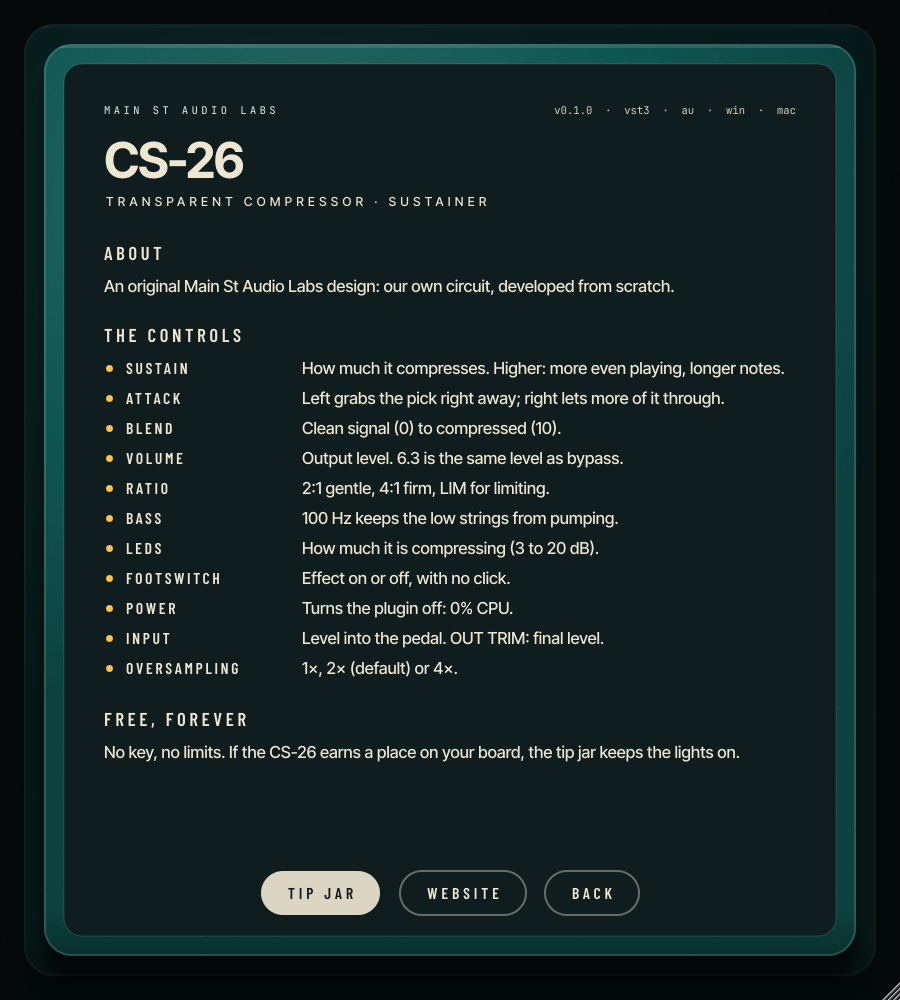
Info
Click INFO to open the info panel: what each control does, the version, the website and the tip jar. Click BACK, or anywhere outside the card, to close it.
Frequently Asked Questions
Why doesn't the level go up when I turn up SUSTAIN?
On purpose. Many compressors raise the level automatically as they compress, and on a guitar that turns into a boost on every pick attack. CS-26 doesn't: VOLUME at 6.3 is the bypass level, and only VOLUME adds level.
Where are the release and the threshold?
SUSTAIN sets the threshold. The release follows your playing on its own: fast after a short, hard note and slower after a long one, so the sustain doesn't swell or pump.
Why is it mono?
Like a pedal, it is mono. A stereo input is summed to mono, and both outputs carry the same signal.
Is it really free?
Yes. No key, no time limit, nothing locked. The tip jar is there if you want to support the lab.
Credits & Trademarks
- An original circuit by Main St Audio Labs, designed and simulated in-house.
- Developed with the JUCE framework.
- Typefaces: Barlow Condensed, JetBrains Mono and Inter Tight (SIL Open Font License 1.1).
All product names, trademarks, and registered trademarks mentioned (including Focusrite) are property of their respective owners and are referenced solely for descriptive purposes. Main St Audio Labs is an independent developer and has no affiliation, endorsement, or commercial sponsorship from these companies.
If you record something with the CS-26, we want to hear it. Copy our email to send us the link:
mainstaudiolabs@gmail.com
Other plugins
New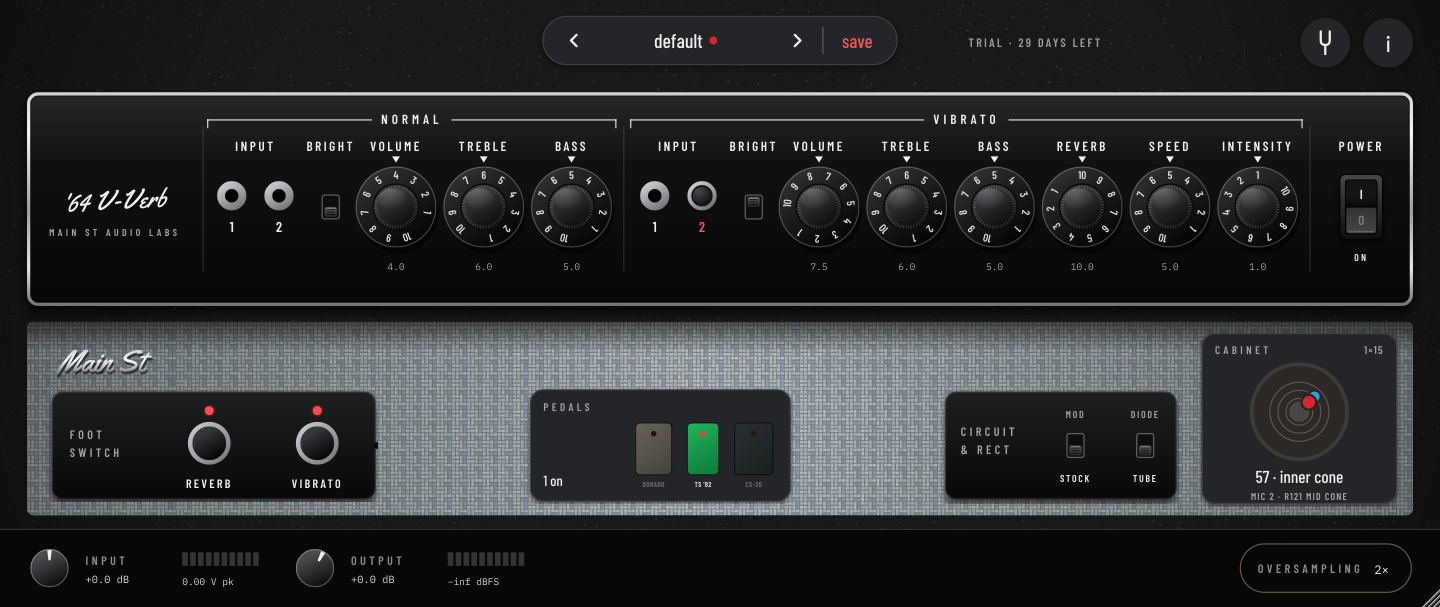
Main St '64 V-Verb
1964 Fender Vibroverb (blackface, 1x15)
The 1964 blackface Vibroverb, rebuilt tube by tube: two channels, a tube-driven spring reverb, the optical vibrato, a pair of 6L6GC, a GZ34 rectifier and a 15" speaker, all working together as in the real amp. Big, round cleans with a lot of headroom, deep reverb and a throbbing vibrato, and a thick, singing edge when you turn it up. With the '64 Custom switches and a pedalboard in front: a compressor and two overdrives.
$19 · trialView details
New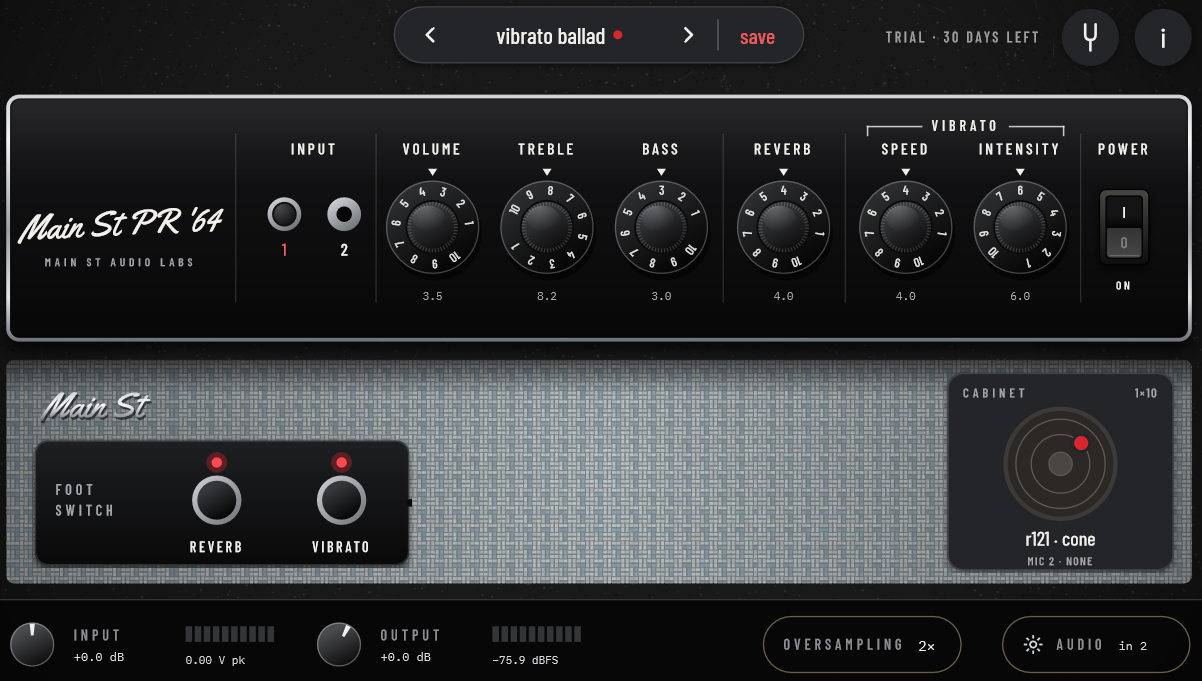
Main St PR '64
1964 Fender Princeton Reverb (blackface)
The 1964 blackface Princeton Reverb, rebuilt tube by tube: the preamp with Treble and Bass, a tube-driven spring reverb, the bias tremolo, a pair of 6V6 and a GZ34 rectifier, all working together as in the real amp. That's why the cleans sparkle and the reverb blooms off your picking, why it gets a warm, singing edge when you turn it up, and why the Vibrato pulses like the real one.
$14 · trialView details
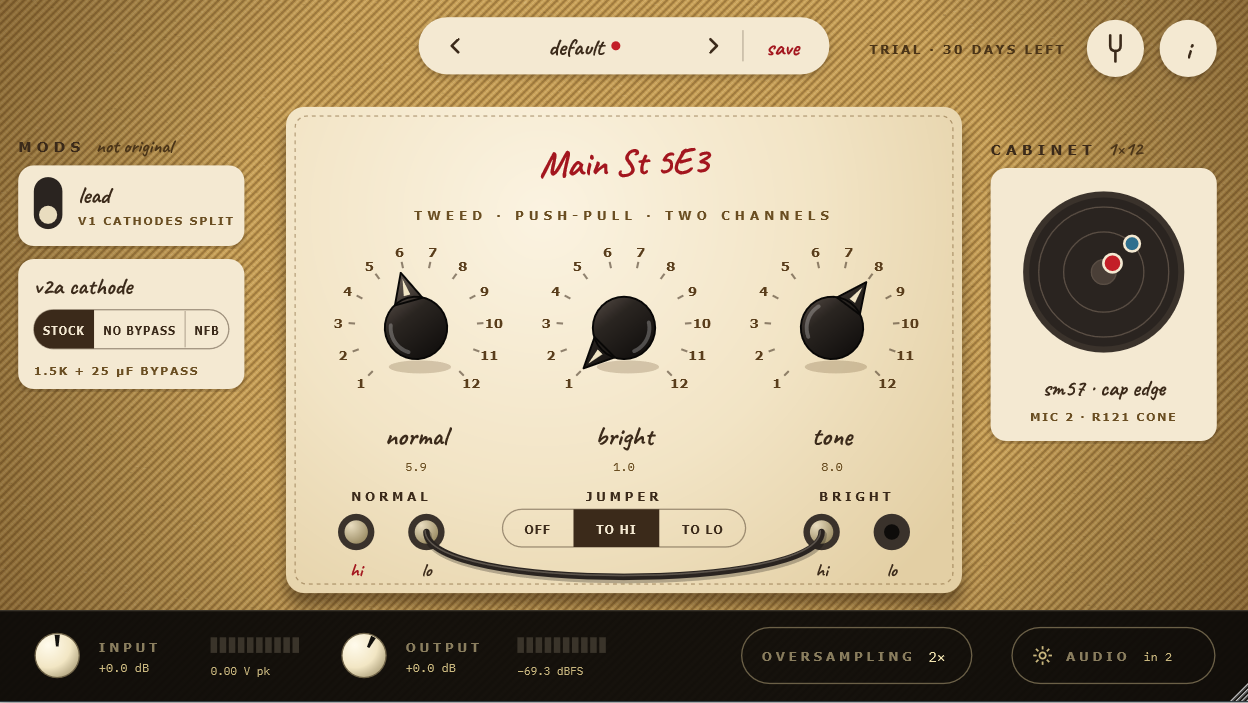
Main St 5E3
Fender Tweed Deluxe 5E3 (1955–60)
The original 5E3 tweed circuit, rebuilt tube by tube: two 12AY7 channels, a 12AX7, a pair of 6V6 power tubes and a 5Y3 rectifier, all working together as in the real amp. That's why it cleans up when you roll back your guitar's volume, sags and compresses when you dig in, and breaks into the famous tweed roar when you crank it.
$9 · trialView details
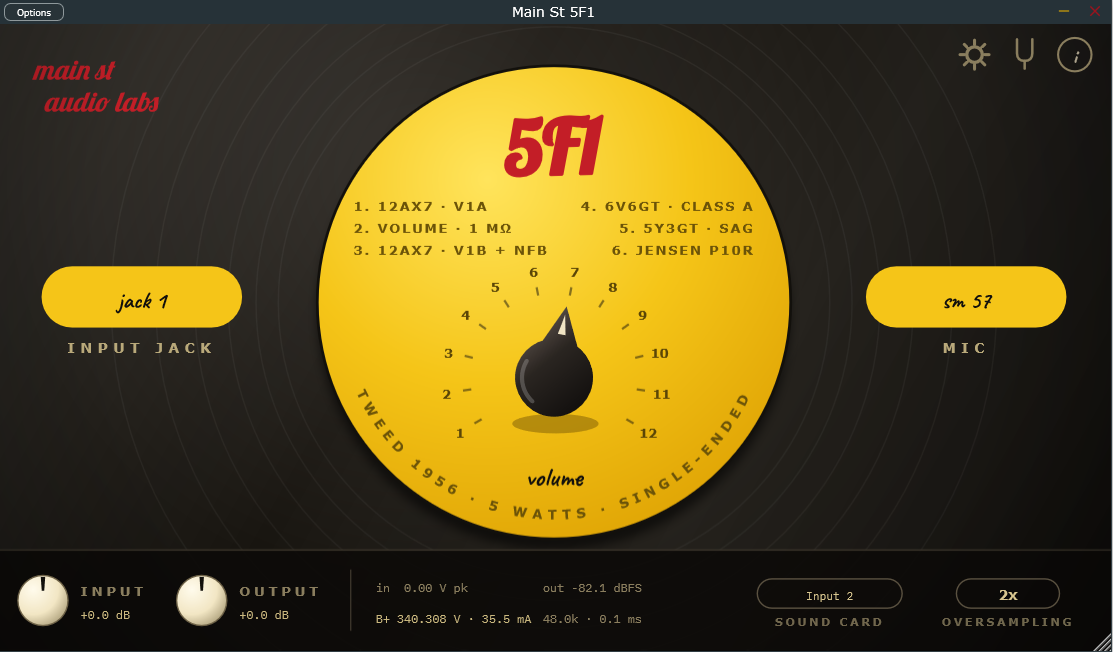
Main St 5F1
1956 Fender Tweed Champ 5F1
The original 1956 tweed Champ circuit, rebuilt tube by tube: a 12AX7, a single 6V6 and a 5Y3 rectifier, working together as in the real amp. That's why one knob covers it all (sweet cleans down low, warm crunch in the middle, singing overdrive at the top) and why it answers your picking like the real thing.
FreeView details
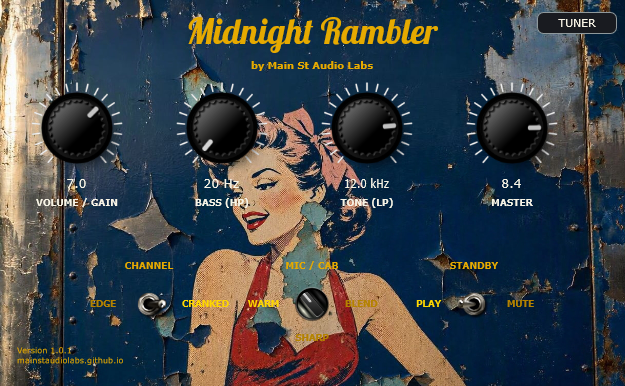
Midnight Rambler
Fender Tweed Deluxe 5E3 · lite
The raw, dynamic bite of the Fender Tweed 5E3 behind rock's landmark albums. Organic touch sensitivity, 3 phase-aligned studio mics, and retro tuner.
FreeView details
New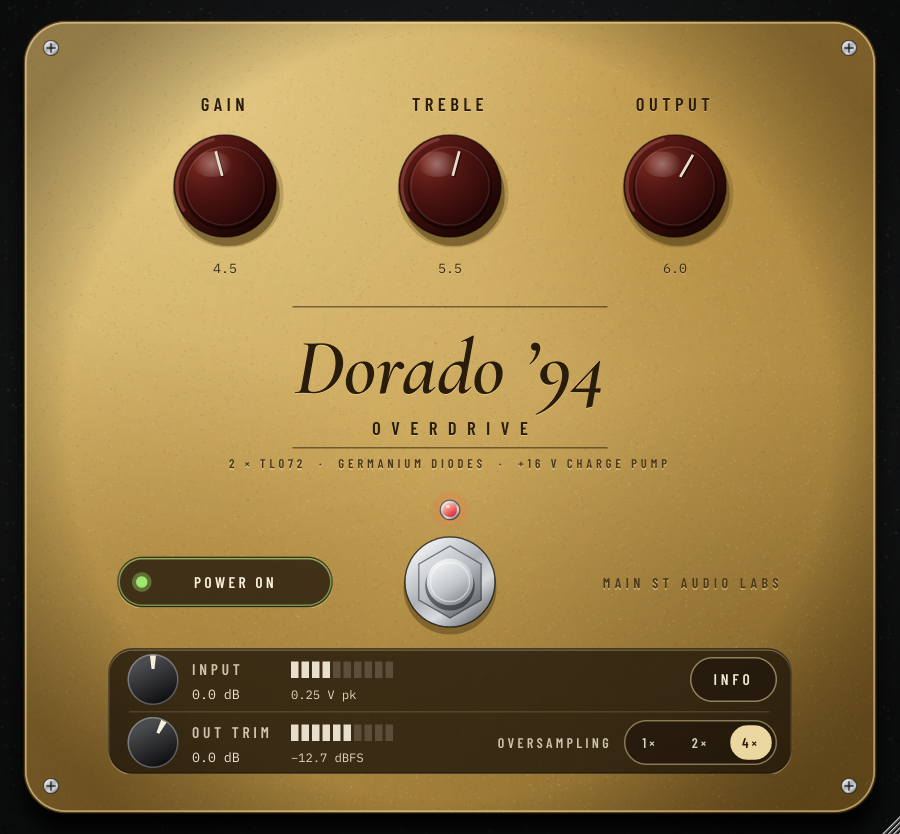
Dorado '94
1994 Klon Centaur overdrive
The famous 1994 transparent overdrive, rebuilt part by part: the buffer, the gain section with its germanium diodes and the clean signal running alongside, the treble control on its charge-pump rails and the original buffered bypass. That's why it thickens your tone instead of replacing it, works as a clean boost with GAIN low, and pushes an amp into singing overdrive when you turn it up.
FreeView details
New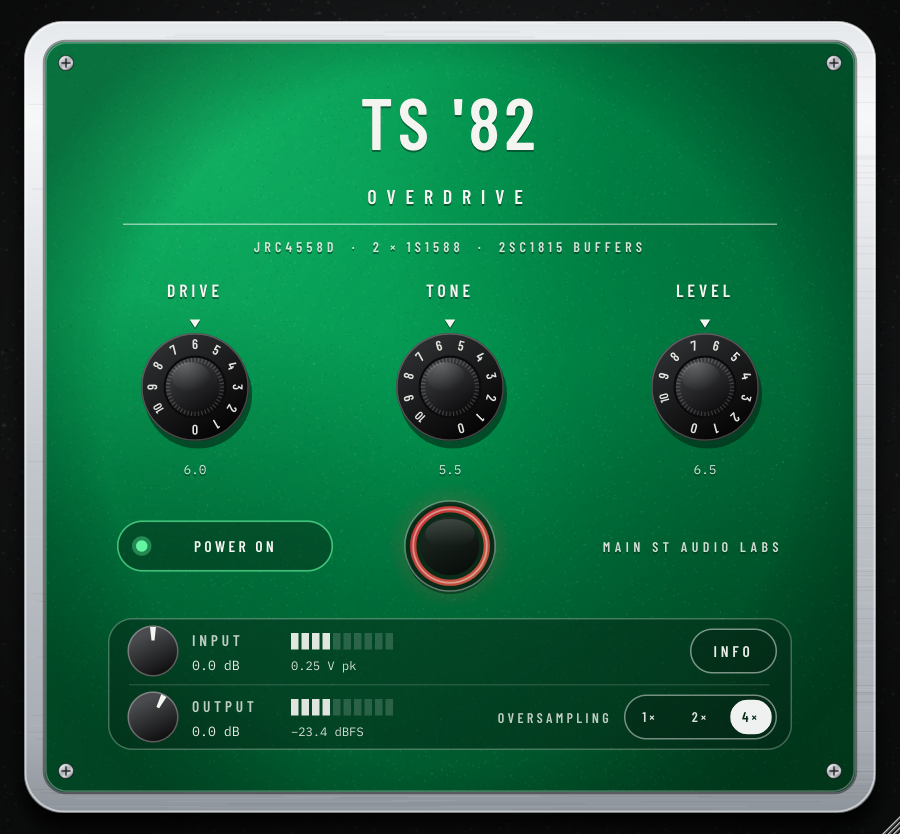
TS '82
1982 Ibanez TS9 Tube Screamer
The 1982 green overdrive, rebuilt part by part: the two transistor buffers, the JRC4558D clipping stage with its silicon diodes, the tone control and the original buffered bypass. That's where the famous mid hump comes from, the tight low end and the smooth clipping that tames your amp, whether you use it for overdrive or as a boost in front of a dirty amp.
FreeView details
New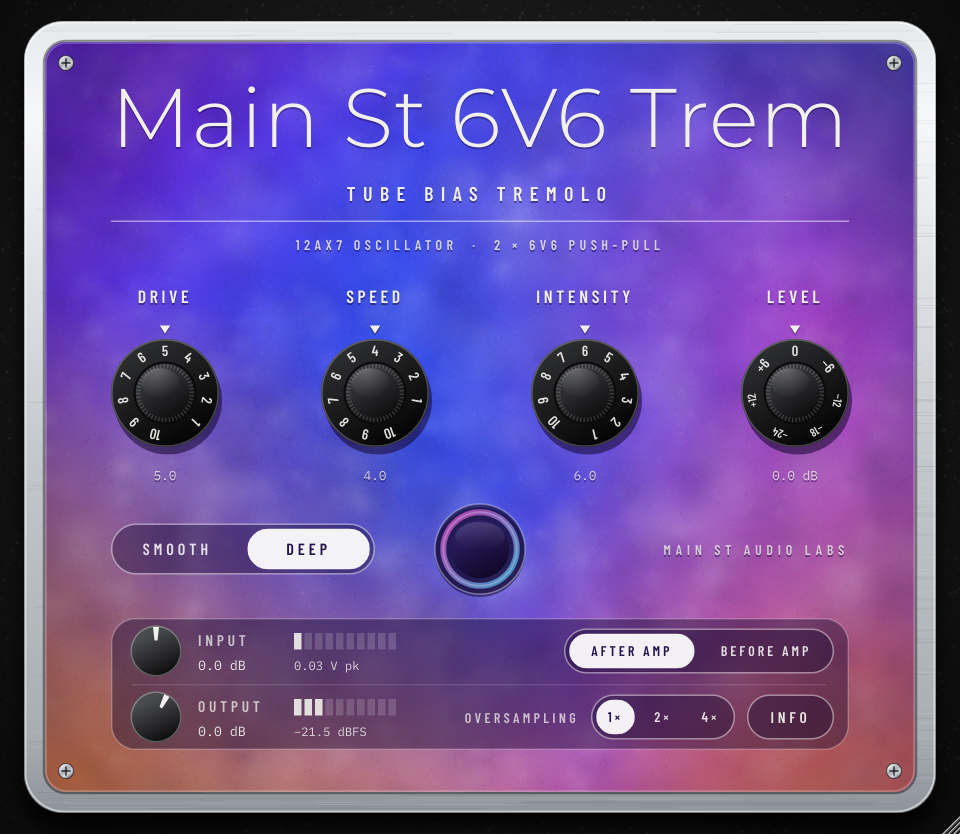
Main St 6V6 Trem
The bias tremolo of the 1964 Princeton Reverb
The bias tremolo of the 1964 blackface Princeton Reverb, taken out of the amp and built into a pedal, tube by tube: the oscillator tube, the bias supply and a push-pull pair of 6V6 with their output transformer. The power tubes make the tremolo, so the pulse is round and warm, it breathes with your playing and each valley gets a little dirty. SMOOTH is the original circuit; DEEP goes all the way down to silence.
FreeView details
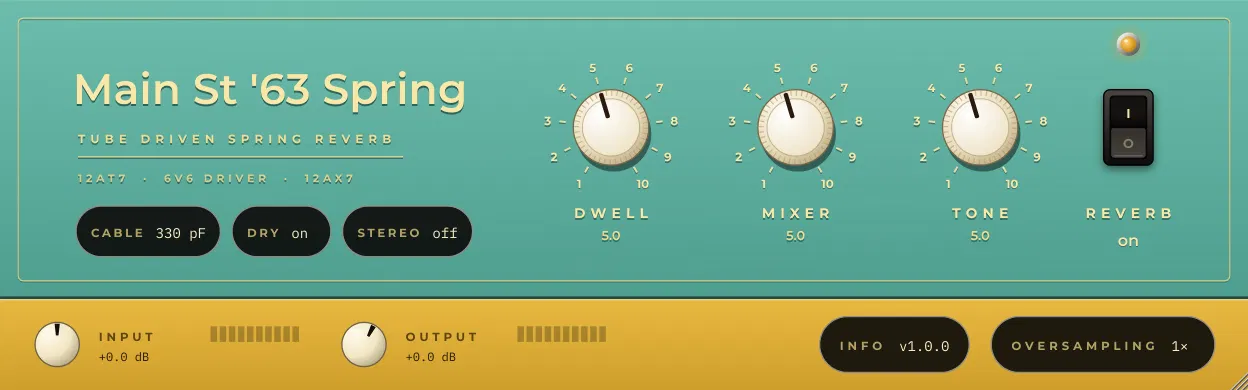
Main St '63 Spring
1963 Fender Reverb Unit (6G15)
The original 1963 outboard spring reverb, rebuilt part by part: the tubes that drive the tank, the two springs and the recovery stage. That's where the drip and splash of surf and vintage records come from, and why it gets wetter and wilder as you turn up the Dwell and hit it harder. Use it before your amp like the original, or on a bus with the springs in stereo.
FreeView details
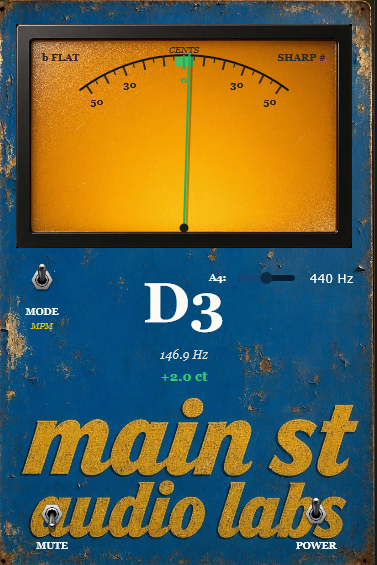
Vintage Tuner Stompbox
Chromatic needle tuner
Vintage needle tuner powered by dual high-precision DSP engines (MPM & YIN). True 0.0% CPU when GUI is closed for inserting across all session tracks.
FreeView details